

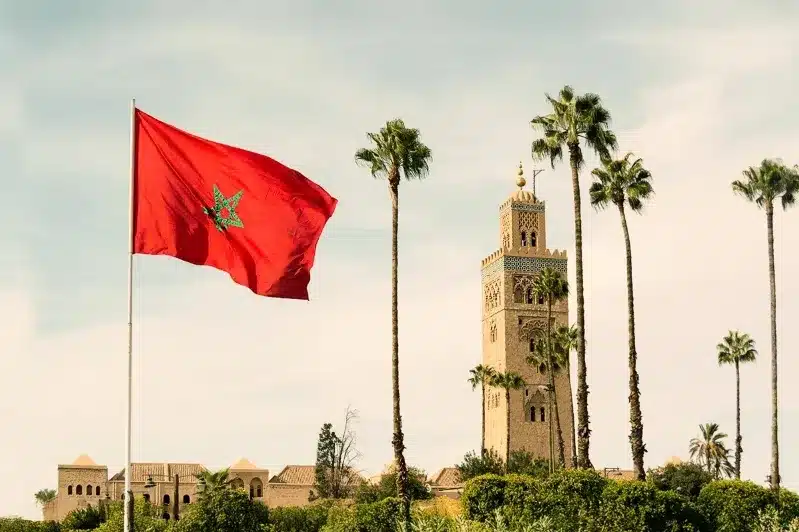
Marrakech is the Moroccan city that absorbed the travel media conversation and hasn’t fully released it. The pink-walled medina, the Djemaa el-Fna square at dusk, the riad hotel aesthetic — these images have been circulated long enough that many travelers treat them as synonymous with Morocco itself. At TrotRadar, we find this simultaneously understandable and mildly frustrating, because the country that exists beyond Marrakech — the medieval complexity of Fes, the blue-washed lanes of Chefchaouen, the Sahara edge at Merzouga, the Atlantic coast at Essaouira — is larger, more varied, and in several respects more rewarding than its most famous city.
This Morocco beyond Marrakech travel guide is for travelers who’ve either already done Marrakech and want to understand what comes next, or who want to build their first Morocco trip around a fuller picture of the country. Both approaches are well-served by the same information.
TrotRadar Tip: Morocco is best explored as a circuit rather than a hub-and-spoke system. Flying into Marrakech and out of Casablanca (or vice versa) allows you to move through the country without backtracking. Budget airlines including Ryanair and easyJet serve multiple Moroccan cities from European hubs. Browse TrotRadar’s Morocco travel deals — we feature open-jaw flight options and riad accommodation packages across the country.
Fes: The Medieval City That Makes Marrakech Look Modern
Fes is the destination that consistently produces the strongest reaction among experienced travelers to Morocco — including those who went expecting Marrakech 2.0 and found something categorically different. The medina of Fes el-Bali — a UNESCO World Heritage Site and the largest car-free urban environment in the world — is a medieval city of approximately 350,000 people operating largely as it has for a thousand years: a labyrinth of 9,000 lanes and alleys containing tanneries, madrasas, mosques, souqs, and neighborhoods organized by trade in the tradition of the medieval Islamic city.
The Chouara Tanneries — the ancient leather-dyeing complex visible from the rooftop terraces of surrounding leather shops — are the image most associated with Fes and one of the most extraordinary industrial heritage experiences in Africa. Stone vats filled with natural dyes (saffron for yellow, poppy for red, indigo for blue, mint for green, henna for orange) and workers treading hides in the pigment have been operating by essentially the same method since the 11th century. The smell is intense; the view is unforgettable; the rooftop access is typically offered by the leather shops for free with a mild expectation of purchase that can be declined politely.
The Bou Inania Madrasa — a 14th-century Quranic school in the heart of the medina — is the finest example of Marinid-era Islamic architecture accessible to non-Muslim visitors in Morocco: an extraordinary interior courtyard of carved stucco, painted wood, and zellige tilework that rewards slow examination of its geometric detail. Entry approximately 70 MAD (€6).
The medina of Fes requires either a guided tour (recommended for first visits — the lane network is genuinely disorienting) or an acceptance that getting lost is the correct strategy. TrotRadar recommends both simultaneously: hire a guide for the first morning to understand the structure, then explore independently for the remaining days.
TrotRadar Fes daily budget:
- Riad guesthouse in the medina: €30–80/night
- Full meal at a local restaurant: €4–9
- Daily total (comfortable): €40–70
Chefchaouen: The Blue City Beyond the Photograph
Chefchaouen in the Rif Mountains has become so thoroughly photographed — the blue-washed lanes, the cat on the step, the flower pot against the indigo wall — that arriving with managed expectations has become necessary. TrotRadar’s honest assessment: the photographs are accurate, and the reality is genuinely beautiful. What the photographs don’t convey is the specific atmosphere of a mountain town at 600 metres, cooler than the coast and the desert, with a particular pace of life that rewards an extra night beyond what the Instagram agenda demands.
The blue paint tradition is genuinely historical — the town’s Sephardic Jewish community, who settled here after the 1492 expulsion from Spain, painted their buildings in the blue associated with heaven in Jewish tradition. The practice was subsequently adopted more widely and has become the defining visual identity of the city.
Beyond the medina photography circuit: the Ras el-Maa waterfall at the top of the medina provides fresh mountain water and a local washing scene that is entirely domestic and entirely photogenic. The hike to the Spanish mosque on the hillside above the city (45 minutes, good trail) delivers the panoramic view over the blue roofscape that the medina lanes themselves don’t permit. The souq on Saturday morning — when farmers and traders from surrounding Rif villages descend — is the most local and most interesting market experience in the northern Morocco circuit.
Getting there: Bus from Fes (4 hours), Tangier (3 hours), or Tétouan (1.5 hours). CTM and Supratours operate reliable services.
TrotRadar Chefchaouen daily budget: €30–55 — significantly cheaper than Marrakech for equivalent quality accommodation.
The Sahara Edge: Merzouga and the Erg Chebbi
The Moroccan Sahara — accessible via the desert town of Merzouga, 50 km south of Erfoud — delivers the dune landscape most travelers associate with the idea of the Sahara: the Erg Chebbi dune field rises to 150 metres above the flat reg (gravel plain), the sand shifting between orange, gold, and pink depending on the hour, the silence absolute beyond the wind.
The standard Sahara experience from Merzouga involves a camel ride into the dunes at sunset, a night in a Berber camp (basic tents or more elaborate “luxury” camps depending on budget), and a return at dawn before the heat builds. TrotRadar’s honest calibration: the camel ride takes 45–90 minutes and is uncomfortable for the uninitiated; arriving at the camp by 4WD and walking into the dunes independently is both faster and more physically pleasant. The camp itself — fire, stargazing, Berber musicians, morning mint tea — is the experience worth prioritising.
Desert camp costs:
- Basic camp (shared tent, dinner, breakfast): €25–45/person
- Mid-range camp (private tent, full board): €60–100/person
- “Luxury” camp (equipped tents, private facilities): €100–200/person
The drive to Merzouga — through the Draa Valley (palmeraies and kasbahs along a river valley), the Todra Gorge (limestone canyon walls 300 metres high, a 1-km walk through extraordinary geology), and the Dades Valley (the “Valley of Roses,” with rose water distilleries in the villages around Kelaat M’Gouna) — is one of the finest driving routes in Morocco. TrotRadar strongly recommends the desert circuit as a self-drive rather than an organised tour if you have the driving confidence.
Essaouira: The Atlantic Alternative to Marrakech
Essaouira — three hours west of Marrakech on the Atlantic coast — is the Moroccan coastal town that most consistently surprises travelers who arrive expecting a beach resort and find something considerably more interesting. The UNESCO-listed medina, built as a Portuguese fortification in the 16th century and redesigned by a French architect in the 18th, has a grid-based layout entirely unlike the labyrinthine medinas of Fes and Marrakech — navigable, breezy (the town is known as the “Windy City of Africa,” and the Atlantic trades blow consistently enough to support a significant kitesurfing industry), and atmospheric in a specifically bleached, blue-and-white coastal way.
The ramparts facing the Atlantic — the skala de la ville — provide the finest sea walk in Morocco: cannon emplacements, waves crashing below, the old town visible behind. The fish market within the blue boat harbour is both photogenic and functional — buy fresh fish in the morning and have one of the adjacent grills cook it for a token fee.
Essaouira is also associated with Jimi Hendrix, who allegedly wrote “Castles Made of Sand” after visiting in 1969 — a connection the town wears lightly enough to be charming rather than exploitative.
TrotRadar Essaouira daily budget: €35–65
The Fes–Chefchaouen–Sahara–Marrakech Circuit
The Morocco beyond Marrakech route that TrotRadar recommends for a 10–14 day trip:
- Fly into Casablanca or Tangier
- Chefchaouen (2 nights) — blue medina, Rif Mountain atmosphere
- Fes (3 nights) — tanneries, medina depth, Bou Inania
- Desert circuit via Ifrane, Midelt, Merzouga (3 nights) — cedar forests, Sahara, Draa Valley return
- Marrakech (2 nights) — the Djemaa el-Fna as a conclusion rather than a beginning
- Essaouira (2 nights) — Atlantic decompression
- Fly out of Marrakech
This circuit covers the four main dimensions of Morocco — imperial cities, mountain towns, desert, and Atlantic coast — in a logical geographic sequence without backtracking. For the solo female travel specifics of navigating Morocco, read TrotRadar’s Africa solo female travel guide, which covers Morocco’s particular dynamics in detail. For context on how Morocco fits into a winter sun strategy, see our winter sun destinations guide.
Practical Morocco Travel Notes from TrotRadar
Transport: CTM and Supratours buses connect all major cities reliably and affordably (Marrakech–Fes: approximately €12, 8 hours overnight). ONCF trains run Casablanca–Fes and Casablanca–Marrakech. Shared taxis (grands taxis) cover shorter intercity routes; negotiate the price before departure.
Currency: Moroccan Dirham (MAD). Approximately 10.5 MAD per €1. ATMs are widely available in cities; cash is preferred for medina shopping and local restaurants.
Language: Darija (Moroccan Arabic) and Tamazight (Berber) are the primary languages; French is widely spoken and understood; Spanish in the north. Learning a few Arabic greetings (As-salamu alaykum — peace be upon you; Shukran — thank you; La shukran — no thank you) produces disproportionate goodwill.
TrotRadar Morocco overall daily budget:
- Budget: €30–45/day (medinas, local food)
- Mid-range: €50–80/day (riads, mix of restaurants)
- Desert camp nights: treat as separate fixed costs of €25–100/night
The TrotRadar Verdict on Morocco Beyond Marrakech
The Morocco beyond Marrakech travel guide case is ultimately simple: Marrakech is one chapter of a book that has nine. The chapter is excellent and worth reading. The book is better than the chapter, and the book is what most visitors don’t finish. TrotRadar’s advice: arrive through Marrakech if you must, but leave through it rather than returning to it. The country that unfolds between the two visits is the one worth traveling for.
Find Your Morocco Travel Deal
TrotRadar features Fes riad stays, Sahara desert camp bookings, Chefchaouen guesthouses, and Morocco circuit packages with open-jaw flights. The full Morocco — beyond the famous pink city — is waiting. Browse TrotRadar’s Morocco travel offers →
