The Azores sit in the middle of the North Atlantic — roughly 1,500 km west of Lisbon, halfway between Portugal and the east coast of North America — and they have absolutely no business being as green as they are. Nine volcanic islands rising from the Mid-Atlantic Ridge, covered in hydrangeas and cattle pasture and calderas filled with lakes that shift between blue and green depending on which way the wind blows the chemistry of the volcanic water. There are places where you can cook a meal in the ground using geothermal heat, and watch sperm whales surface 15 minutes from shore, and hike between cloud forest and sea cliff in the same afternoon.
At TrotRadar, the Azores sit in a very specific category: destinations that overdeliver on every dimension simultaneously. This Azores Portugal travel guide is for travelers who’ve heard the name floating around the edges of travel conversations for a few years and finally want to understand why people who’ve been there tend to go back. The short answer is that the Azores are genuinely unlike anywhere in Europe — and at a price point that remains, despite increasing popularity, significantly below comparable island destinations in the Mediterranean.
TrotRadar Tip: The Azores are accessible year-round, but May–September offers the best weather and the best whale watching. Direct flights from the UK, Germany, and several other European countries make access easier than most travelers expect. Check TrotRadar’s current Azores flight and island-hopping deals — we regularly feature packages that include inter-island flights via SATA AirPass.
Getting There: Surprisingly Accessible
The Azores are served by SATA Air Açores (the regional carrier) and Azores Airlines from Lisbon, as well as direct transatlantic flights from Boston, Toronto, and several US cities during summer months. Ryanair, TAP, and easyJet also operate routes from various European cities.
Ponta Delgada on São Miguel is the main hub — most flights arrive here, and if you’re visiting only one island, São Miguel is the one to choose. Inter-island flights are operated by SATA and can be booked through their website; ferry connections between some islands exist in summer but are weather-dependent.
SATA AirPass is worth investigating if you’re visiting multiple islands — a package of inter-island flight coupons that reduces the per-island cost significantly versus booking individually.
For context on how the Azores compare to other dramatic North Atlantic islands, TrotRadar’s Faroe Islands travel guide and Iceland budget travel guide cover the full spectrum of Atlantic island options at different budget levels.
São Miguel: Where to Start (and Possibly End)
São Miguel is the largest island in the archipelago and contains enough to occupy most travelers for a full week without feeling like they’ve missed anything critical.
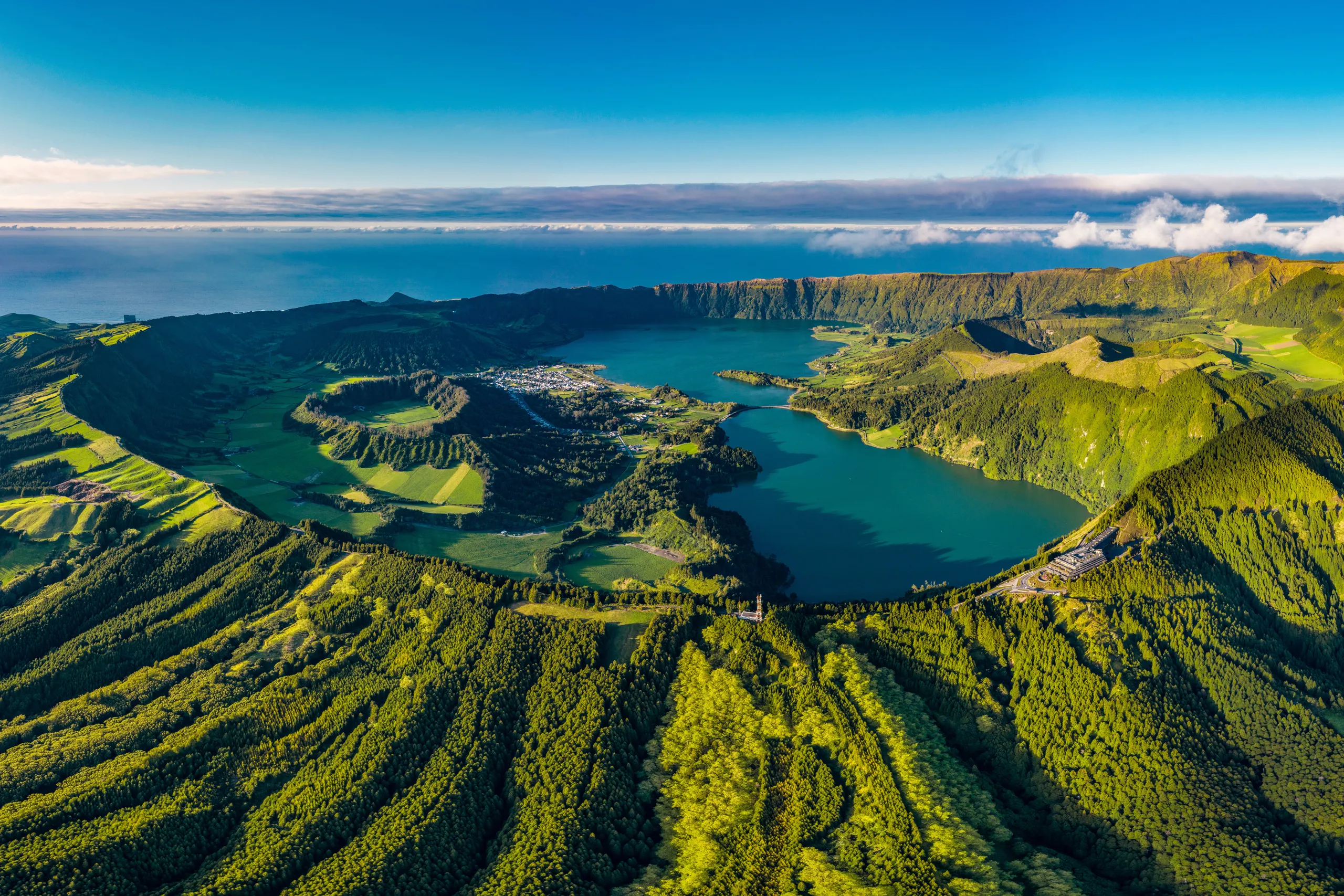
Sete Cidades is the defining image of the Azores — a vast volcanic caldera containing two crater lakes (one blue, one green, separated by a narrow bridge) set against walls of impossibly green vegetation. The viewpoint from Vista do Rei on the caldera rim gives you the classic panorama. The caldera floor is accessible by road and offers a completely different perspective — kayaking on the lakes costs approximately €15–20 for a couple of hours and is one of the island’s best experiences.
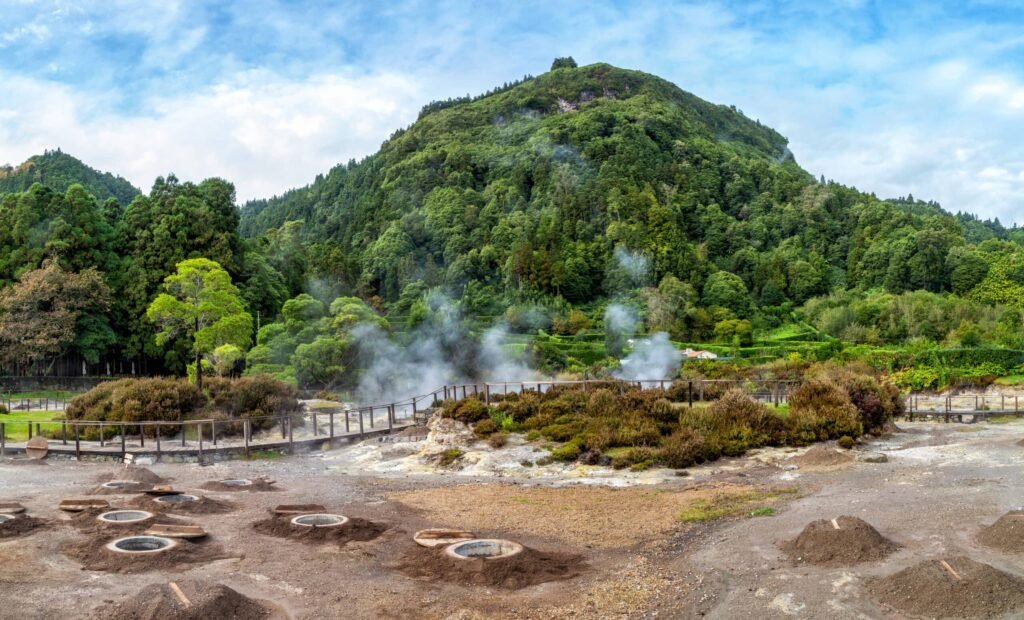
Furnas is a valley in the eastern part of São Miguel where geothermal activity comes closest to the surface. Boiling mud pools and steaming fumaroles are scattered through the landscape, and the local specialty — cozido das Furnas (a meat and vegetable stew cooked underground in a pot lowered into a geothermal vent for several hours) — is one of the more genuinely unusual food experiences in Europe. The TrotRadar team considers this a non-negotiable Azores meal.
Nordeste, the northeast corner of São Miguel, is the part that most day-trippers don’t reach — a sequence of viewpoints along sea cliffs so dramatically eroded they look computer-generated, with villages where tourism hasn’t yet replaced fishing and farming as the local economic base. Driving the northeast coast road is one of the best half-day drives in the entire archipelago.
Whale Watching in the Azores: World-Class and Accessible
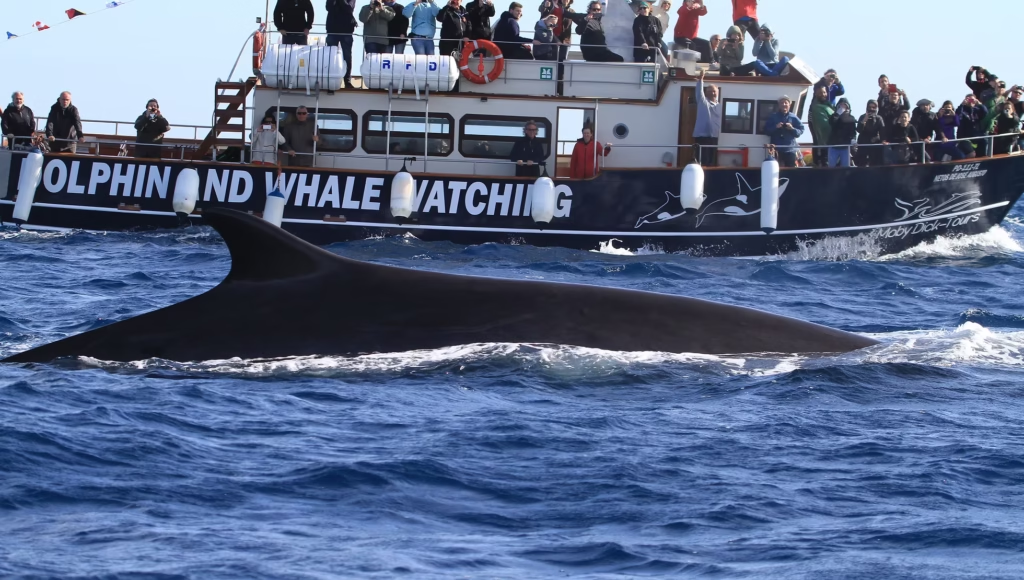
The Azores are one of Europe’s best places for whale watching, with more than 20 cetacean species recorded in Azorean waters — the deep waters of the Mid-Atlantic Ridge create conditions that attract 24 of the world’s 80-plus cetacean species. Sperm whales are present year-round; blue whales, fin whales, sei whales, and multiple dolphin species pass through seasonally.
Tours operate from Ponta Delgada and Madalena (Pico), typically running 3–4 hours on rigid inflatable boats with a lookout (called a vigia) stationed on the clifftop with binoculars, communicating whale positions by radio to the boats below — a system that evolved from the old Azorean whaling industry and is now entirely repurposed for observation.
Encounter rates for sperm whales are remarkably high — operators typically report 95%+ sighting success rates during the main season (April–October). Tours typically cost €55–75 per person and are an unambiguous highlight of any Azores visit. TrotRadar recommends choosing an operator explicitly committed to low-impact viewing — for guidance on selecting ethical wildlife tourism operators, see our sustainable travel guide.
Faial: The Blue Island
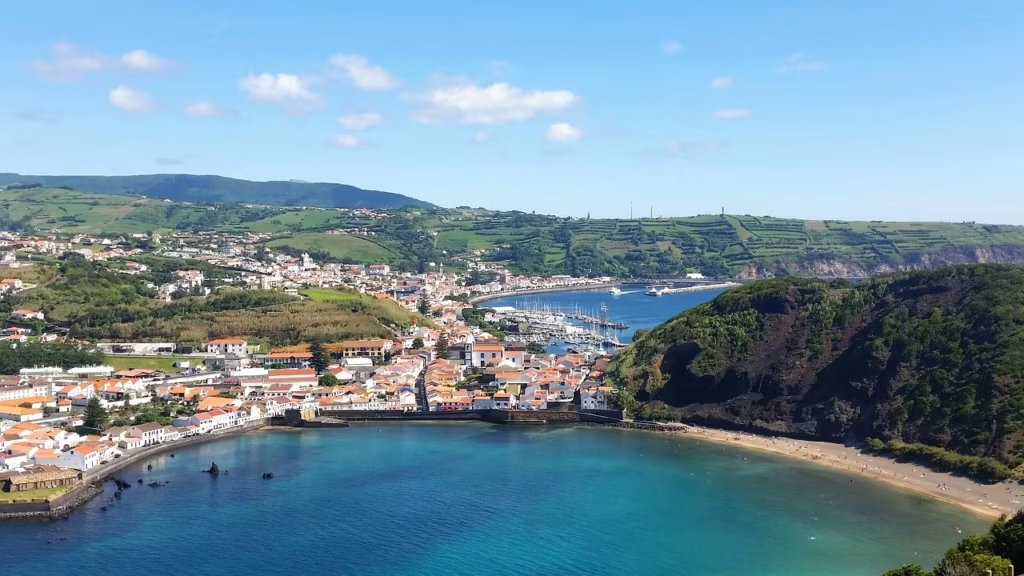
Faial is called the “Blue Island” because of the hydrangeas that line virtually every road and field boundary across the island from June to August — miles of blue blooms that make the landscape look deliberately planted for aesthetic effect (it wasn’t; hydrangeas were introduced as boundary markers and simply thrived in the Atlantic climate).
Horta, the main town, has one of the most famous marina cultures in the transatlantic sailing world — boats crossing the Atlantic make Horta a standard waypoint, and the tradition of leaving a painted mural on the breakwater before departure has accumulated over decades into an extraordinary wall of layered maritime art. The Peter Café Sport in Horta has been serving sailors and travelers since 1918 and is still the social center of the harbor — and one of TrotRadar’s favorite bars anywhere in Europe.
The western tip of Faial contains the Capelinhos Volcano — a cinder cone created by an underwater eruption in 1957–58 that added 2.4 km² to the island’s surface over 13 months. The surrounding landscape of black volcanic ash, half-buried lighthouse, and desolate lava fields stands in complete visual contrast to the rest of lush Faial and is one of the most atmospheric geological sites in Europe.
Pico Island: Vineyards, Volcanoes, and Silence
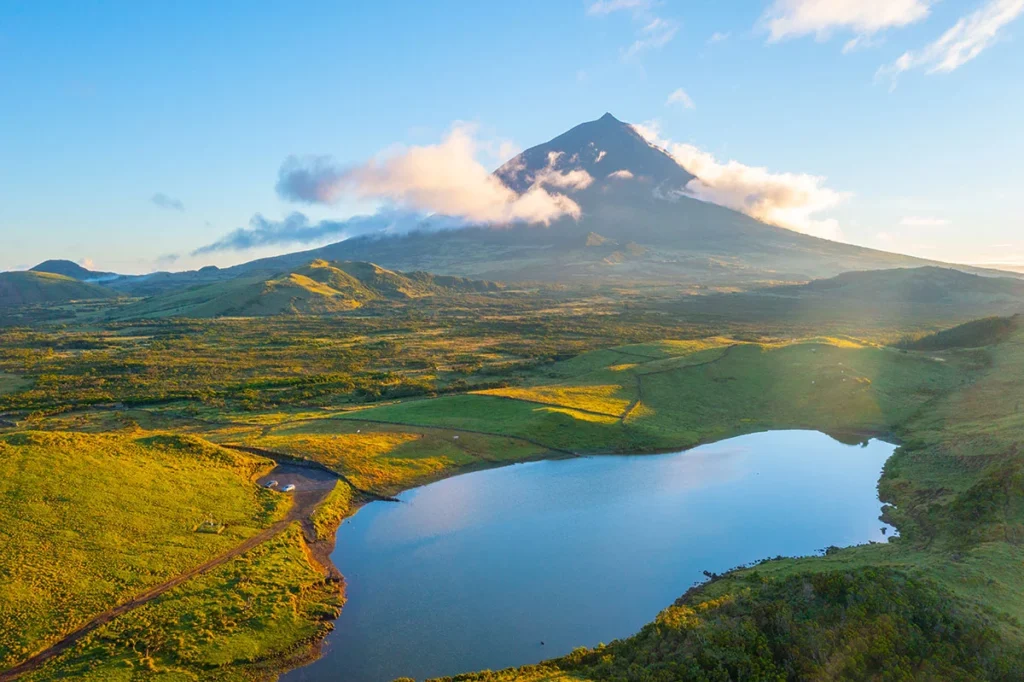
Pico is defined by two things: its volcano and its wine. Mount Pico (2,351 m) is the highest point in Portugal and a demanding but non-technical day hike — the ascent takes approximately 3–4 hours one way, requires registration and a guide for the upper section, and on clear days offers views of multiple other islands across the Atlantic.
The Pico wine is grown in a system of basalt rock enclosures (currais) that break the wind and retain the heat of the black volcanic soil for the grape vines. The visual effect is extraordinary — a UNESCO-listed agricultural landscape of geometric black rock walls running down to the sea. The wine produced here, primarily from the Verdelho grape, is dry, mineral, and distinctively saline from the Atlantic influence.
Several adega (winery) visits are available across the island, many free or offered for a small tasting fee. Pico remains significantly quieter than São Miguel and Faial — the right choice if your ideal Azores experience involves hiking, wine, and genuine silence over organized attractions. For a comparative perspective on other Atlantic wine regions worth discovering, see TrotRadar’s Alentejo Portugal travel guide.
Costs and Practical Notes from TrotRadar
Accommodation: The Azores have matured as a destination, and accommodation prices reflect that. In Ponta Delgada, budget guesthouses run €50–80/night for a private room; on quieter islands like Pico or Flores, €40–65/night is more typical. Rural tourism properties — quintas and country houses — offer some of the best value and atmosphere in the archipelago.
Food: Azorean food is Portuguese in character with local specificity. Bifanas (pork sandwiches) and fresh fish are the affordable staples. Lapas (grilled limpets with butter and garlic) are the essential local starter. A full dinner at a local restaurant runs €12–20/person including wine.
TrotRadar Azores daily budget:
- Budget traveler (self-catering, hiking focus): €50–70/day
- Mid-range (guesthouse + activities): €70–110/day
- The whale watching tour (€55–75) is worth treating as a fixed trip cost separate from the daily budget
When to go: May–September for best weather and whale watching. June–August is peak for hydrangeas on Faial. October–April offers lower prices and a quieter, greener, moodier version of the islands.
The TrotRadar Verdict on the Azores
The Azores are the correct answer to a question that a lot of European travelers are quietly asking: where can I go that feels genuinely wild and different, is accessible from home in under three hours by air, won’t demand a summer-in-Santorini budget, and will give me something to think about for years afterward?
Nine islands. Volcanic lakes. Sperm whales. Geothermal stew. Black rock vineyards. The TrotRadar verdict: book the flight.
Find Your Azores Island Deal
TrotRadar features current deals on direct flights to Ponta Delgada, inter-island SATA passes, and island-hopping packages across São Miguel, Faial, and Pico. Europe’s wildest islands are closer than you think. Browse TrotRadar’s Azores travel offers →