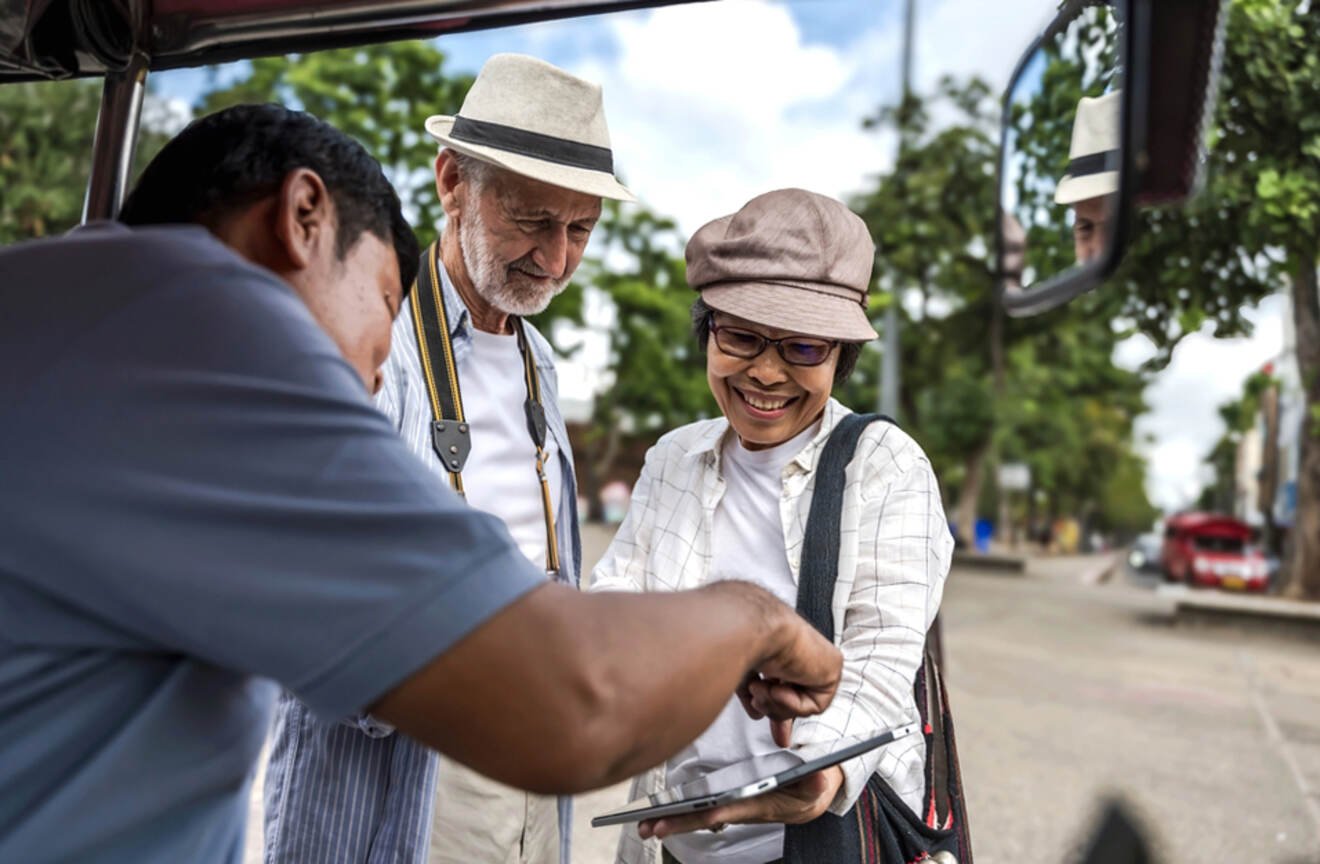
Learning a language while traveling can turn everyday moments (ordering food, asking directions, meeting locals, and navigating transport) into real practice. But travel alone does not create fluency: meaningful progress comes from combining daily study with active conversations and feedback.
This practical guide explains how to learn a language while traveling through language exchanges, short daily study sessions, comprehensible input, real-world conversations, and a simple routine you can maintain on the road. You will also find destination ideas for Spanish, Portuguese, and French learners.
TrotRadar Tip: Start learning the language before you arrive — not weeks before, but at least 2–3 weeks. Arriving with 200 words and the ability to make basic sentences transforms the immersion experience from overwhelming to productive. A beginner who arrives with zero knowledge spends the first week learning things they could have learned at home. Browse TrotRadar’s language immersion travel packages — we feature language school accommodation combinations in Spanish, Portuguese, and French-speaking destinations.
The Foundation: Why Passive Exposure Isn’t Enough
Consider the thousands of foreign tourists who visit any major city annually without learning a word of the local language. They are immersed for the duration of their stay and arrive home no more capable of speaking that language than when they left. The immersion context is necessary but insufficient without deliberate engagement.
The specific thing that travel provides for language learning is not passive exposure but motivation and opportunity: the immediate daily context where using the language has real stakes and real rewards (a better price at the market, an unexpected conversation, the specific respect that attempting the local language generates across virtually every culture TrotRadar has traveled through), and the motivation of wanting to communicate with specific people in a specific place rather than with a textbook character in an imagined situation.
That motivation and opportunity, combined with deliberate daily practice, produces a language learning rate that structured classroom study typically cannot match — not because the classroom is bad but because the feedback loop between study and real-world use is compressed from weeks to hours when you’re living in the language’s context.

The Five Methods That Actually Work
1. The Language Exchange (Intercambio)
The language exchange is TrotRadar’s single strongest recommendation for language learning while traveling. The format: you spend 30 minutes speaking the language you’re learning, 30 minutes speaking English (or your native language) for your partner’s learning, over coffee in a café, at a cost of only the coffee and an hour of your time.
How to find language partners:
- Tandem app: The most reliable platform for finding language exchange partners — available in most cities globally, free for basic use
- HelloTalk: Similar to Tandem, with a stronger in-app messaging and voice recording correction feature
- Local university noticeboards: Spanish, Portuguese, and French-speaking university cities typically have language exchange club announcements — the most reliable source of motivated, English-learning partners
- Conversation class at a local language school: Many language schools in popular learning destinations (Guatemala’s Antigua, Cusco, Medellín, Lisbon) run evening conversation exchanges that are open to walk-ins for a minimal fee
TrotRadar’s exchange quality tip: the first exchange is always slightly awkward; the third with the same person is where genuine language learning begins. Finding two or three regular exchange partners and meeting them three times per week produces significantly better results than meeting one new person daily.

2. Deliberate Daily App Practice
Language apps work — when used deliberately rather than as a gamified daily tick in a streak. TrotRadar’s honest assessment of the main options:
Duolingo: Best for vocabulary acquisition and maintaining daily habit. Weak on grammar explanation and real conversation preparation. The most useful language learning app at the absolute beginner stage; less useful once basic vocabulary is established. TrotRadar uses it for the first 200 words in a new language and then supplements heavily.
Anki: Spaced repetition flashcard software — free, unglamorous, and significantly more effective than Duolingo for vocabulary retention over time. The learning curve is higher (you create or download decks rather than following a preset curriculum) but the memory science behind spaced repetition makes it the most efficient pure vocabulary tool available. Pre-made language decks are available for most major languages.
Babbel: Better grammar explanation than Duolingo; more structured curriculum; subscription-based. TrotRadar recommends it over Duolingo for travelers who want conversational grammar structure rather than vocabulary lists.
Pimsleur: Audio-only language learning — specifically designed for speaking and listening comprehension. Ideal for language practice during walking, commuting, or transit. TrotRadar’s recommendation for Spanish and Portuguese learners specifically — the audio focus produces better speaking confidence than text-based approaches.

3. Structured Input: Reading and Listening at Level
The comprehensible input hypothesis (language acquisition researcher Stephen Krashen’s framework) proposes that language acquisition happens primarily through understanding messages slightly above your current level — “i+1” in his notation. The practical application for travelers:
- Children’s books at the level you’re actually at: The embarrassment of reading a children’s book in your target language is genuinely useful — the vocabulary and grammar are at the level where you understand 80–90% (the threshold where acquisition happens) rather than 20–30% (where you’re spending energy on decoding rather than absorbing)
- Podcasts for language learners: Coffee Break Spanish, SpanishPod101, FrenchPod101, and equivalents for most major languages provide graded audio input with explanations — the most time-efficient listening practice available during transit and walking
- Netflix with dual subtitles: A show in your target language with target-language subtitles (not English translation) — available through the Language Reactor browser extension — provides natural speech pattern exposure at a pace you can pause and rewind

4. The Deliberate Conversation Habit
The most powerful language learning habit available to a traveler is the decision to attempt every daily transaction in the local language — not the first sentence and then switching to English when it gets hard, but the full interaction: ordering food, asking directions, negotiating transport, buying things at markets.
This is uncomfortable. You will fail at things. People will switch to English because it’s easier for them. TrotRadar’s approach to the English-switch problem: thank them for their patience, ask if they’d mind practicing your [language] with you, and usually they’ll engage positively. The worst that happens is they say no — and you’ve asked in the target language, which is itself practice.
A useful target from TrotRadar’s experience: aim for 10 “real” conversations in the target language per day — not monologues or transactions, but genuine exchanges of more than three sentences. Track them roughly; the habit of counting forces the habit of creating the opportunities.

5. The Grammar Investment
Grammar is the aspect of language learning that most app-only learners skip and that creates a ceiling on progress. TrotRadar’s honest position: you cannot reach conversational competence in most languages without understanding at least the core verb conjugation patterns, the gender and number agreement rules, and the basic sentence structure.
The investment is smaller than it sounds: the core grammar of Spanish, for example, can be absorbed to a functional level in approximately 10 hours of focused study from a resource like Spanish: An Essential Grammar (Routledge Essential Grammars series) or the equivalent for your target language. TrotRadar recommends dedicating one or two full travel days early in a language-focused trip to this foundation work — the return on those two days over the subsequent weeks of practice is significant.
The Best Travel Destinations for Language Learning
Not all destinations are equally well-suited to language learning travel. The best combine: a large population of native speakers who want to practice with you (or who don’t speak your language at all, forcing you to use theirs), an established language school infrastructure, and a daily cost that makes an extended language learning stay financially sustainable.
Spanish:
- Antigua, Guatemala: TrotRadar’s top recommendation — the most affordable Spanish school infrastructure in Latin America (one-to-one lessons from $5–8/hour), a beautiful colonial city, and a culture of genuine linguistic engagement with foreigners
- Medellín, Colombia: Colombian Spanish is considered the clearest and most neutral accent in Latin America — excellent for learners who will be using Spanish across the continent. Good school infrastructure at mid-range prices ($10–15/hour)
- Oaxaca, Mexico: Another TrotRadar recommendation — a colonial city with excellent schools and the additional cultural richness of Zapotec indigenous linguistic tradition alongside the Spanish learning context
Portuguese:
- Florianópolis, Brazil: The southern Brazilian city with excellent school infrastructure and clearer Brazilian Portuguese pronunciation than Rio or São Paulo
- Lagos or Faro, Portugal: European Portuguese in an Algarve setting — slower pace, smaller city, more opportunity for genuine daily conversation
French:
- Lyon, France: The food capital of France is also TrotRadar’s French language recommendation — more affordable than Paris, more genuine in character, and the specific motivation of learning French in order to understand the food culture more deeply is a surprisingly effective driver of vocabulary acquisition
- Montpellier, France: Large student population, affordable cost, south France climate — excellent language school infrastructure
For the complete digital nomad and slow travel framework that supports an extended language learning stay, read TrotRadar’s digital nomad destinations guide and our slow travel benefits guide.
The TrotRadar Language Learning Travel Framework
Synthesizing everything above into a daily travel language learning schedule that TrotRadar has found genuinely productive:
- Morning (30–45 minutes): Anki vocabulary review + one Pimsleur or podcast lesson while getting ready or having breakfast
- Midday: One real conversation (language exchange, market interaction, restaurant order in full sentences)
- Afternoon: Reading input in the target language (graded reader, children’s book, local newspaper with a dictionary)
- Evening: Netflix with target-language subtitles, or a second conversation exchange session
This schedule adds approximately 1.5–2 hours of deliberate language learning to a travel day without sacrificing the experience of actually being somewhere. Over a four-week trip, that’s 40–60 hours of concentrated practice — more than most semester university courses provide in total contact time, done in the environment where the language is actually used.
Managing the Frustration: What TrotRadar Has Learned
Every language learner encounters the same frustrating experience: you’ve been studying for three weeks, you feel like you’ve made no progress, and a native speaker still switches to English after your first sentence.
TrotRadar’s honest reassurance: language acquisition has a specific pattern that involves a long plateau followed by a rapid breakthrough — the “click moment” that experienced language learners describe when the language stops being a translation exercise and starts being comprehensible directly. This typically happens between 100 and 200 hours of practice. The plateau before it is real, normal, and not evidence of failure.
The specific habit that accelerates through the plateau: write one paragraph per day in the target language (diary entry, description of the day) and ask a language partner or teacher to correct it. The written production forces grammar engagement that conversation allows you to avoid, and the corrections produce targeted feedback on exactly the errors you’re making rather than the polite non-corrections of most conversational exchanges.
The TrotRadar Verdict on Language Learning While Traveling
How to learn a language while traveling reduces to one insight: the travel provides the motivation and the opportunity; the learning requires the deliberate daily practice. Neither alone is sufficient. Together, in the right destination with the right daily routine, they produce the specific experience that language learners describe as transformative: the first conversation you have entirely in the new language, about something real, with someone who genuinely responded.
That moment is available to any traveler who invests the thirty minutes per day. TrotRadar has had it in four languages and recommends it unreservedly.
Find Your Language Learning Travel Deal
TrotRadar features language school and accommodation combinations in Antigua Guatemala, Medellín, Oaxaca, Lisbon, and Lyon — full immersion packages that combine structured morning classes with afternoon and evening real-world practice. Browse TrotRadar’s language immersion travel offers →