
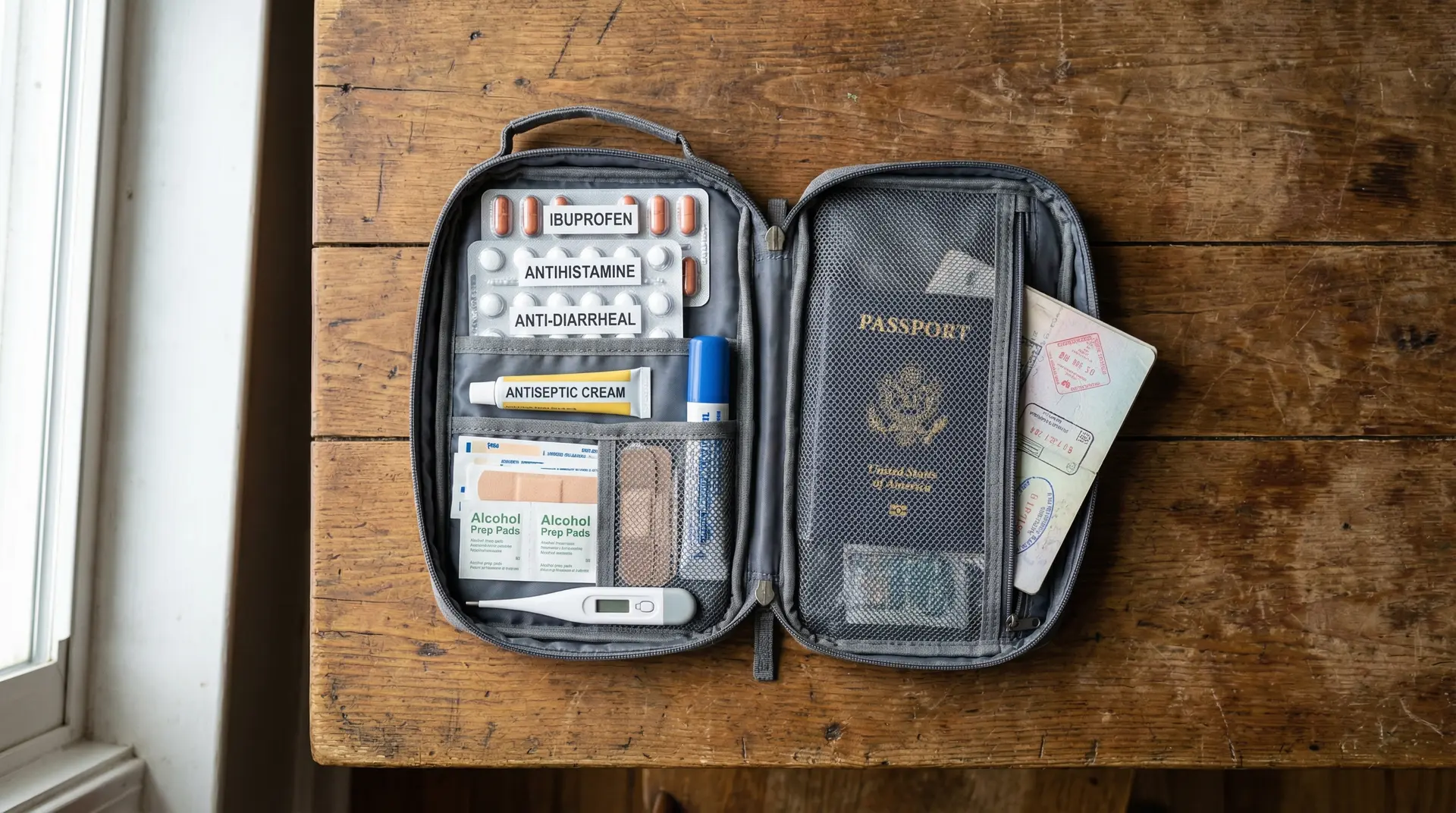
Traveling with medical conditions can be safe, rewarding, and realistic with the right preparation. Whether you manage diabetes, heart disease, an autoimmune condition, epilepsy, mental health needs, or reduced mobility, planning your medications, documents, insurance, and destination healthcare can prevent avoidable problems abroad.
This guide explains how to travel with medical conditions confidently: what to discuss with your doctor, how to carry medication safely, how to choose travel insurance for pre-existing conditions, and how to plan for emergencies without letting health concerns define your trip.
TrotRadar Tip: The single most useful document for traveling with a medical condition is a signed letter on clinic letterhead from your prescribing doctor — covering your conditions, current medications (generic names and doses), emergency protocols, and your doctor’s contact details. Most travelers with medical conditions don’t have this, and most who’ve needed it describe the difference it makes as significant. Get it before you go. Browse TrotRadar’s travel insurance deals — including specialist policies covering pre-existing conditions.
The Pre-Travel Medical Consultation: Making It Useful
The “consult your doctor” instruction becomes useful when it’s specific. The questions to bring to a pre-travel consultation are not generic (“is it safe to travel?”) but operational:
Medication-specific questions:
- Will my condition or medication be affected by significant time zone changes? (Critical for medications with specific dosing windows — insulin, anticoagulants, antiepileptics)
- Are there interactions between my regular medications and common travel medications (antimalarials, altitude medication, standard antibiotics)?
- What is the generic (non-brand) name of each medication I take in case I need to source it abroad?
- Which countries have restrictions on my specific medications? (Japan, UAE, Indonesia have restrictions on medications freely prescribed elsewhere)
Condition-specific questions:
- Are there climates or altitudes that would adversely affect my condition?
- What are the early warning signs of deterioration to monitor, and at what point should I seek local medical care?
- Can I get a signed letter on clinic letterhead describing my condition, current treatments, and emergency protocols — in English and ideally in the language of my destination?
That last point — the medical letter — is the single most practically useful document most travelers with medical conditions don’t have and should.

Medications: The Logistics That Prevent Emergencies
Carry more than you need. The standard TrotRadar recommendation is double the medication required for the trip duration plus a buffer. A two-week trip should carry four to five weeks of medication. This sounds excessive until a flight cancellation or unexpected extension makes it necessary.
Split between bags. Medication goes in both carry-on and checked bags — never exclusively in checked baggage, which can be delayed, lost, or temperature-compromised in cargo. The carry-on portion should always contain enough for the full trip.
Temperature-sensitive medications — insulin, certain biologics, eye drops, some liquid medications — require specific attention:
- FRIO cooling wallets (water-activated evaporative cooling pouches, no refrigeration required) keep insulin and similar medications at safe temperatures for 45+ hours in ambient temperatures up to 37°C — TrotRadar’s most consistently recommended medication travel accessory
- Notify airlines when booking if refrigeration is required on-board (most major airlines accommodate with advance notice)
- Research refrigeration availability at accommodation before booking
Controlled substances and border crossing: Japan, UAE, Indonesia, and several other countries have restrictions or outright bans on medications freely prescribed elsewhere. The INCB Travel Advisory website and destination country embassy websites are the correct sources for this information. Some countries require a specific import certificate obtained before travel — research and obtain these well in advance.
Documentation for medications:
- Original pharmacy-labeled packaging for all prescription medications
- A copy of the original prescription or letter from prescribing doctor
- The medical letter from your consultation
- For controlled substances: import certificate where required

Travel Insurance: The Pre-Existing Condition Complexity
Travel insurance for travelers with pre-existing conditions is significantly more complex than standard travel insurance — and the stakes of getting it wrong are higher. The core problem is the pre-existing condition exclusion — the standard clause in most basic policies that excludes medical costs from conditions existing before the policy was purchased.

The solutions:
- Specialist pre-existing condition travel insurance: AllClear, Free Spirit, and Staysure (UK); Battleface and IMG Global (North America) are well-reviewed specialist providers. These require medical disclosure and cost more — worth every additional cent
- Medical screening accuracy: Disclose every condition, every medication, and every recent hospitalization or specialist appointment. Insurance companies investigate claims against medical records — incomplete disclosure voids coverage entirely
- Medical evacuation is non-negotiable: Ensure the policy specifically covers evacuation for your condition category, with a minimum of $250,000 coverage — not just accident-related evacuation
For TrotRadar’s complete travel insurance guide — covering coverage types, the pre-existing condition look-back period, and provider recommendations — read our dedicated travel insurance guide 2026.
Destination Research: Matching Your Condition to the Environment
Not all destinations are equally appropriate for all medical conditions — and honest pre-trip research about destination healthcare quality, altitude, climate, food safety, and disease risk produces planning that is specific rather than generic.

Healthcare infrastructure: Japan, Western Europe, Australia, Singapore, and Taiwan have healthcare systems of the highest international standard. Much of Africa, rural Southeast Asia, and remote South America have limited facilities that may require evacuation to the nearest major city for specialist treatment. Match the remoteness of your itinerary to your medical risk tolerance and evacuation insurance coverage.
The IAMAT directory (International Association for Medical Assistance to Travelers) maintains a database of English-speaking doctors meeting international standards in over 90 countries — available free to members (free to join). Identify the nearest IAMAT-listed physician before arriving in each destination — having this information available before you need it is infinitely preferable to researching it during a health event.
Altitude considerations:
- Heart conditions, respiratory conditions, and severe anemia require specific medical advice before high-altitude travel (above 2,500 metres)
- Cusco (3,400 m), La Paz (3,650 m), and the Tibetan Plateau require specific pre-travel cardiac assessment
- Even moderate altitude (Kathmandu at 1,400 m, Addis Ababa at 2,355 m) can affect some respiratory conditions
Climate considerations:
- Heat and humidity significantly affect multiple sclerosis symptoms, some cardiac conditions, and medications that are temperature-sensitive in the body
- Cold climates affect Raynaud’s disease, certain arthritic conditions, and some respiratory situations
Mental Health: The Condition Most Travel Guides Don’t Address
Mental health conditions — depression, anxiety disorders, bipolar disorder, PTSD, OCD — affect a significant proportion of travelers and are almost entirely absent from travel health guidance. TrotRadar’s practical framework:
Medication continuity is essential. Many psychiatric medications have serious discontinuation effects if doses are missed or delayed — SSRIs, SNRIs, mood stabilizers, antipsychotics. The same carry-double, split-between-bags protocol applies with even greater force for medications where missing a dose has significant behavioral consequences.
Time zone changes affect dosing timing. Psychiatric medications often have specific timing requirements; significant time zone crossings require a dosing transition plan discussed with your prescriber before departure.
Travel itself is a mental health stressor for many — the loss of routine, unfamiliar environments, social isolation, disrupted sleep. Building predictability into an itinerary (consistent accommodation style, known meal routines, planned downtime) reduces this stressor significantly. TrotRadar’s slow travel benefits guide covers the specific structural approaches that reduce travel-related stress.

Know when to stop. The most important mental health travel decision is the prior agreement with yourself about what conditions would warrant cutting a trip short — and having travel insurance that covers trip interruption for mental health deterioration (many standard policies don’t; specialist insurers increasingly do).
Mobility and Physical Access
Wheelchair users and travelers with reduced mobility face a destination-specific accessibility landscape that ranges from excellent (Netherlands, Scandinavia, Japan, most of Western Europe) to significantly challenging (cobblestone historic centers, developing world destinations with limited infrastructure).

TrotRadar’s mobility travel framework:
- Research destination accessibility specifically. Wheelchairtravel.org, Accessible Japan, and the Disabled Travellers network provide destination-specific, user-generated accessibility information more current and accurate than most published guidebooks
- Contact accommodation directly. The gap between “accessible room available” and “actually navigable for your specific situation” is often significant — describe your needs precisely and ask specific questions (step heights, bathroom equipment, lift access)
- Notify airlines at booking. Airlines provide wheelchair assistance, pre-boarding, aisle wheelchair transfer, and seat assignment accommodation with advance notification — the DPNA (Disabled Passenger, Needing Assistance) code can be added to most bookings
The Medical Information Card
Every traveler with a significant medical condition should carry a medical information card — a wallet-sized document (or phone lock screen note) containing:
- Full name and date of birth
- Blood type
- Primary diagnosis/diagnoses
- Current medications (generic names, doses)
- Known allergies (particularly drug allergies)
- Emergency contact name and number
- Home country doctor’s contact
- Medical alert information (insulin-dependent diabetic, carries epinephrine, pacemaker fitted)
This information should be available in English and, for non-English-speaking destinations, in the local language. Medical alert jewelry (MedicAlert Foundation equivalents) provides emergency responders with critical information when a traveler cannot communicate.
For the full travel insurance context relevant to medical conditions — including the specific coverage types that matter — read TrotRadar’s travel insurance guide 2026. And for the long-haul flight specifics of managing medications across time zones, see our long-haul flight tips guide.
The TrotRadar Verdict on Medical Condition Travel
Traveling with medical conditions requires more preparation, more documentation, better insurance, and more destination research than traveling without them. What it does not require is not traveling. The frameworks in this guide exist to close the gap between the legitimate complexity of managing health on the road and the actual experience of travel that is safe, planned, and genuinely rewarding. Plan specifically. Pack carefully. Insure comprehensively. And go — because the medical condition is part of your life, not the definition of it.
Find Travel Insurance for Pre-Existing Conditions
TrotRadar features specialist pre-existing condition travel insurance policies, medical evacuation coverage, and adventure activity extensions — compared honestly so travelers with health conditions can travel with genuine confidence rather than false reassurance. Browse TrotRadar’s medical travel insurance offers →