

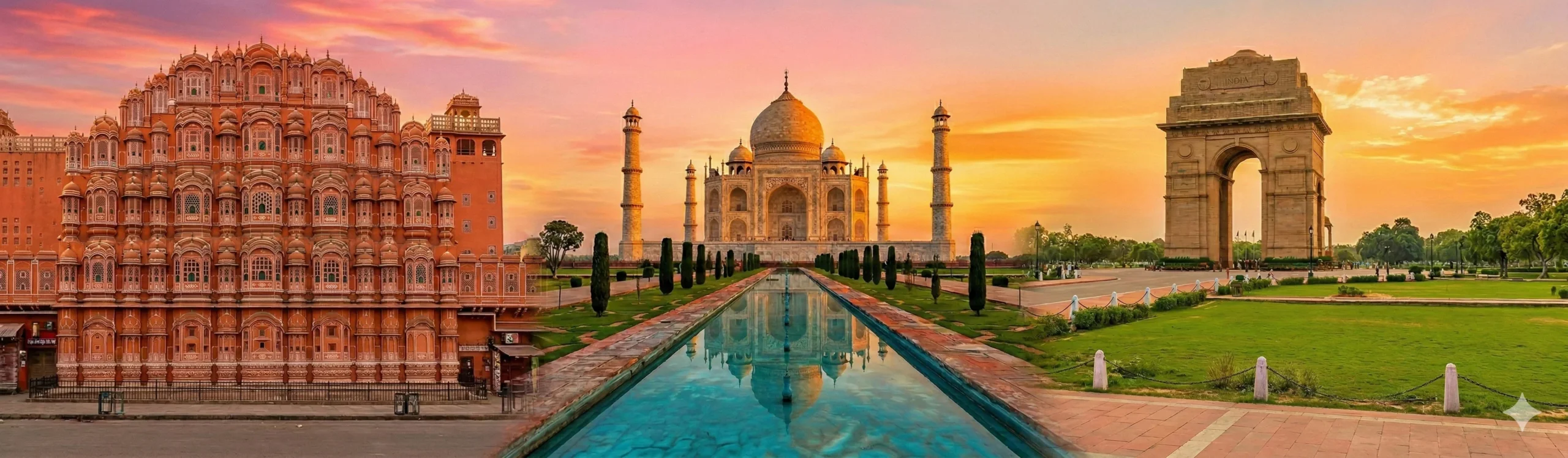
The India Golden Triangle — the roughly equilateral route connecting Delhi, Agra, and Jaipur across a 720 km circuit in northern India — is the most visited tourist route in the subcontinent and the starting point for more first India trips than any other circuit. The reasons are self-evident: three cities of extraordinary historical and cultural significance, each within a manageable drive of the others, containing between them some of the finest examples of Mughal, Rajput, and colonial-era architecture on earth.
At TrotRadar, we approach the India Golden Triangle travel guide with a specific editorial position: the circuit is genuine — these are extraordinary places — but the difference between experiencing it well and experiencing it as an exhausted series of heritage monuments ticked off a list comes down almost entirely to pace, preparation, and the quality of specific information about each site. This guide provides all three.
TrotRadar Tip: The Taj Mahal entry permit must be purchased in advance through the Archaeological Survey of India’s online portal — walk-up tickets are limited and frequently unavailable at peak times. Book your Taj Mahal entry before you book accommodation in Agra. Browse TrotRadar’s India Golden Triangle tour packages and hotel deals — we feature pre-arranged entry permits alongside accommodation combinations that remove the most stressful logistics.
Delhi: Give It More Days Than You Think You Need
Delhi polarises travelers reliably and immediately — the density, the heat, the traffic, the particular sensory intensity of a city of 32 million people operating at full volume. At TrotRadar, we consider this polarisation a reliable indicator that a destination has genuine character rather than a curated experience, and Delhi has more genuine character per square kilometre than almost any capital city on earth.
Most travelers allocate two nights to Delhi as a transit point. TrotRadar recommends three, specifically for the reason that the city’s finest experiences require time to find and unhurried engagement to appreciate.
Old Delhi (Shahjahanabad): The 17th-century Mughal city built by Shah Jahan around the Red Fort (Lal Qila) is the historic core. The Chandni Chowk — the main bazaar avenue running west from the fort’s Lahori Gate — is one of the great sensory experiences in Asian travel: a kilometre of street food stalls, spice merchants, silver jewellers, wedding shop clusters, textile dealers, and the particular compressed noise of Delhi commerce in a lane built for pedestrians and currently navigated by pedestrians, cycle rickshaws, auto-rickshaws, and the occasional cow simultaneously. It requires presence of mind and rewards it.
The Jama Masjid — one of the largest mosques in Asia, built by Shah Jahan in 1656, its courtyard capable of holding 25,000 worshippers — is directly accessible from Chandni Chowk and a genuinely extraordinary space: vast red sandstone and white marble, the three domes and two minarets visible from much of Old Delhi, the muezzin’s call carrying over the city’s noise with specific authority. Entry for non-Muslims: ₹300 (approximately €3.30), including the modest dress requirement fulfilled by robes available at the entrance.
New Delhi: The imperial capital built by the British and completed in 1931 — India Gate, Rashtrapati Bhavan (the President’s House, designed by Edwin Lutyens), and the vast ceremonial boulevards — provides a completely different register of Delhi’s architectural history. The National Museum on Janpath is one of the finest collections of Indian art and archaeology in the world — TrotRadar recommends at least three hours here before moving to the Mughal monuments.
Humayun’s Tomb: Built in 1572 as the first garden-tomb in the Indian subcontinent and the direct architectural forerunner of the Taj Mahal — more serene, less visited, and arguably more beautiful in its proportions. Entry: ₹600 (€6.60). TrotRadar considers it essential preparation for understanding the Taj Mahal’s place in a building tradition.
TrotRadar Delhi daily budget:
- Budget guesthouse in Paharganj (backpacker district): ₹800–1,500 (€8.80–16.50)
- Mid-range hotel in Connaught Place or South Delhi: ₹3,000–6,000 (€33–66)
- Full day of eating locally: ₹400–800 (€4.40–8.80)
- Daily total (mid-range): €35–65
Agra: The Taj Mahal and What Surrounds It
The Taj Mahal is simultaneously one of the most photographed structures on earth and one of the few buildings that consistently exceeds its photographic reputation in person. TrotRadar has heard this from more travelers than any other single statement about any other heritage site — the scale, the precision of the symmetry, the specific quality of white Makrana marble in morning light, the calligraphy panels that frame each arch — none of it fully readable from a photograph.
TrotRadar’s Taj Mahal strategy:
- Arrive at gate opening (30 minutes before sunrise). This is the single most impactful decision you make about the Taj Mahal visit. The building in the first hour after dawn — with mist from the Yamuna behind it, the light warming from grey to gold to white — is the Taj Mahal that Shah Jahan designed. By 9 AM, the atmosphere shifts toward the experience of sharing the space with thousands of others simultaneously.
- Walk the full complex. Most visitors photograph the main view from the central pool and leave. The mosque and guest house flanking the main mausoleum, the interior chamber (the cenotaphs of Shah Jahan and Mumtaz Mahal, their real tombs directly below in the crypt), and the garden design all reward time.
- The Agra Fort view. The Agra Fort (Lal Qila) — 3 km from the Taj, also built by Shah Jahan and his grandfather Akbar — has a terrace from which the Taj Mahal is visible across the Yamuna River, the classic long-distance view. Entry: ₹650 (€7.15). TrotRadar considers this the second-best Taj Mahal view and the most significant architectural site in Agra after the Taj itself.
The honest Agra assessment: Beyond the Taj Mahal and the Agra Fort, Agra is a medium-sized Indian city without exceptional character. Two nights is sufficient — one evening for the sunset Taj view from Mehtab Bagh (the garden across the river, sometimes called the “Black Taj site”), one dawn for the gate-opening arrival. Don’t stay four nights expecting the same quality of experience to continue indefinitely.
TrotRadar Agra daily budget:
- Guesthouse near the Taj: ₹1,000–2,500 (€11–27.50) budget; ₹3,000–8,000 (€33–88) mid-range
- Taj Mahal entry (foreigner rate): ₹1,100 (€12.10) — book online in advance
- Daily total (mid-range): €30–55
Jaipur: The Pink City’s Depth Beyond Its Colour
Jaipur — the “Pink City,” named for the terracotta pink colour used to paint the old city’s buildings for a royal visit in 1876 and maintained by municipal regulation ever since — is the Golden Triangle’s most visually distinctive destination and the one that rewards the longest stay.
The city’s four primary heritage sites operate on significantly different price tiers for foreign visitors — TrotRadar recommends purchasing the Jaipur Composite Ticket (approximately ₹1,000/€11 for foreigners, valid two days) which covers the City Palace, Jantar Mantar, Hawa Mahal, and several other sites at a combined rate considerably below individual entry prices.
Amber (Amer) Fort: 11 km north of Jaipur, the Rajput palace complex of Amber is the finest example of the Rajput-Mughal architectural hybrid in northern India — an elaborate warren of courtyards, mirror halls (Sheesh Mahal), gardens, and temples built over successive rulers from the 10th to 18th centuries. TrotRadar recommends the morning slot (open from 8 AM) before tour groups arrive from Jaipur hotels at 9–10 AM. The elephant rides to the fort entrance (which have attracted animal welfare concerns — TrotRadar recommends the jeep alternative) are no longer the default; walk or take a jeep for the ascent.
Jantar Mantar: An 18th-century astronomical observatory built by Maharaja Jai Singh II — 19 architectural astronomical instruments, the largest of which is the world’s largest stone sundial (accurate to within 2 seconds). TrotRadar considers it one of the most extraordinary and most undervisited UNESCO World Heritage Sites in India — the science behind the instruments is fascinating; a guide significantly enriches the visit.
Jaipur’s food scene: Rajasthani cuisine is among the finest in India — dal baati churma (lentil soup with baked wheat balls and sweet ground wheat, the regional staple), laal maas (red mutton curry, intensely spiced), and the extraordinary Jaipur sweets tradition (ghevar, mawa kachori, and the dozens of milk-based sweets from the Laxmi Mishthan Bhandar on Johari Bazaar are TrotRadar’s picks). Dinner at a rooftop restaurant with views over the pink city: ₹400–800 (€4.40–8.80) for a full Rajasthani thali.
For the broader India context — how the Golden Triangle fits into a longer India itinerary — TrotRadar’s Asia street food guide covers India’s extraordinary food culture, and our solo travel guide covers India’s specific solo travel dynamics in the South Asia section.
TrotRadar Jaipur daily budget:
- Budget guesthouse in the old city: ₹800–2,000 (€8.80–22)
- Mid-range hotel: ₹2,500–6,000 (€27.50–66)
- Daily total (mid-range): €30–60
Transport Between the Three Cities
Delhi to Agra: The Gatimaan Express is the fastest connection (1h40m, departs Hazrat Nizamuddin Station, ₹755–1,505 depending on class). The Shatabdi Express (2h, same stations) is a slightly slower alternative with good availability. Both book through IRCTC (the Indian Railways booking platform) — create an account before travel, as the platform is required for online booking and registration can take 24–48 hours for international bank verification.
Agra to Jaipur: No direct express service — bus (4–5 hours, approximately ₹500/€5.50 for AC sleeper) is often the more reliable option. The Agra–Jaipur highway passes through Fatehpur Sikri — the abandoned Mughal capital built by Akbar in 1571 and deserted within 14 years due to water shortage — a UNESCO World Heritage Site worth a 2-hour stop on the drive between cities.
Jaipur to Delhi: Multiple daily Shatabdi and Jan Shatabdi trains (4.5–5 hours); private bus services also connect the cities in similar time.
Private car hire: For the complete Golden Triangle circuit, many travelers hire a private car with driver for 5–7 days — approximately ₹12,000–18,000 ($145–218 USD) total for the circuit, which includes the Fatehpur Sikri stop and complete schedule flexibility. For a group of two or more, this becomes competitive with train fares while adding considerable comfort and convenience.
Practical India Golden Triangle Notes from TrotRadar
Visas: Most nationalities apply for an India e-Tourist Visa (available at indianvisaonline.gov.in) — processing typically takes 3–5 business days, cost $25–100 USD depending on nationality. Apply at least 2 weeks before travel.
Health: Typhoid and Hepatitis A vaccinations are strongly recommended. Malaria risk in the Golden Triangle cities is low but present — consult a travel health clinic for current recommendations. Drinking bottled water only throughout; ice in restaurants is a judgment call based on the establishment’s standard.
Currency: Indian Rupee (INR). Approximately 91 INR per €1 as of recent rates. ATMs widely available; cash preferred at local restaurants, markets, and heritage entry points.
TrotRadar India Golden Triangle overall daily budget:
- Budget: ₹2,000–3,500 (€22–38)/day
- Mid-range: ₹4,000–8,000 (€44–88)/day
- Heritage entry fees should be budgeted separately — total circuit entry (Taj, Agra Fort, Amber, City Palace, Jantar Mantar, Humayun’s Tomb, Red Fort) approximately €55–65 in total
The TrotRadar Verdict on the India Golden Triangle
The India Golden Triangle travel guide deserves one closing point that most itinerary guides don’t make: the circuit is not India. It is an extraordinary sample of one architectural tradition within one geographic region of a subcontinent with roughly twenty distinct architectural traditions across thirty-six states. If the Golden Triangle is your first India experience, TrotRadar strongly encourages treating it as the first chapter rather than the complete book — Kerala, Rajasthan beyond Jaipur, Varanasi, the northeast, Hampi — all of these are entirely different chapters in a country that rewards a lifetime of return visits.
But the first chapter is extraordinary. Arrive at the Taj before dawn. Eat the dal baati churma in Jaipur. Get comprehensively lost in Chandni Chowk. India will do the rest.
Find Your India Golden Triangle Deal
TrotRadar features Delhi–Agra–Jaipur circuit packages with pre-arranged Taj Mahal permits, private car hire options, and curated hotel combinations across all three cities. India’s most iconic circuit, planned properly. Browse TrotRadar’s India travel offers →
