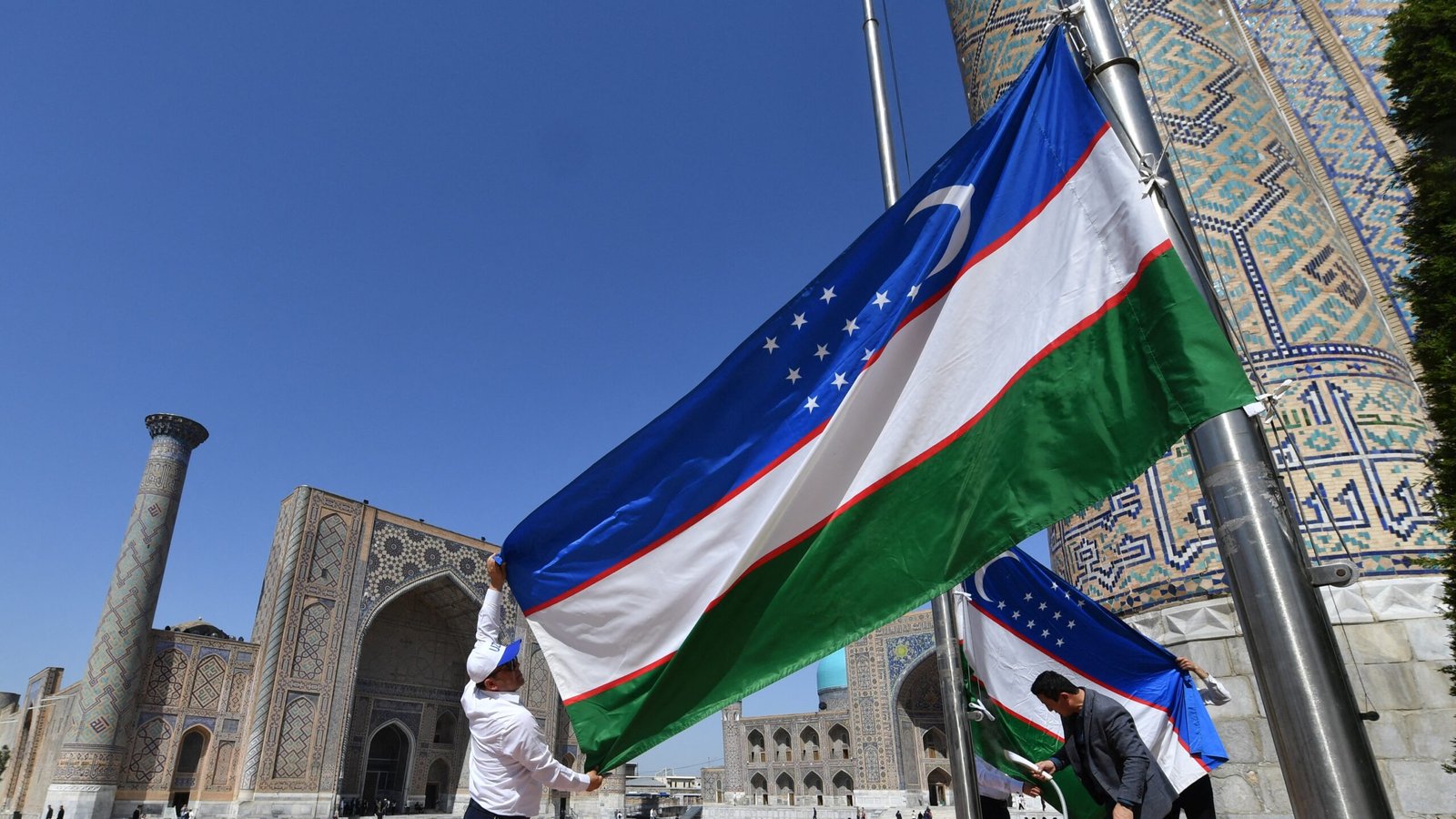
Samarkand gets the cover photograph. TrotRadar gave it the dedicated guide it deserves earlier. But Uzbekistan is a country of three major Silk Road cities — not one — and the traveler who flies in and out via Samarkand alone returns having seen the finest example of one architectural tradition while missing the finest example of another entirely. Bukhara‘s intimate medieval cityscape and Khiva‘s walled inner city are not lesser versions of Samarkand — they are distinct expressions of the same Timurid and Uzbek architectural tradition that together make the country the finest Silk Road destination accessible to independent travelers anywhere in Central Asia.
At TrotRadar, this Uzbekistan travel guide beyond Samarkand edition covers the complete circuit — Tashkent as the practical gateway, the high-speed rail connections between cities, Bukhara’s UNESCO-listed center, Khiva’s walled inner city, and the Fergana Valley’s craft traditions — with the practical logistics that make it one of the most efficient and affordable heritage circuits in Asia.
TrotRadar Tip: Uzbekistan’s Afrosiyob high-speed rail connects Tashkent, Samarkand, and Bukhara efficiently — but Khiva requires either a domestic flight or a slow overnight train from Bukhara (12 hours). TrotRadar recommends flying Bukhara–Urgench (the closest airport to Khiva, 35 km away) on Uzbekistan Airways for approximately $40–60 rather than losing a full day on the overnight train. Browse TrotRadar’s Uzbekistan Silk Road packages — we feature rail pass combinations and multi-city accommodation deals.
Tashkent: The Gateway Worth Exploring
Most Uzbekistan travelers treat Tashkent as a connection point — a night before the morning high-speed train to Samarkand. TrotRadar recommends two full days, specifically because the capital contains experiences unavailable in the historic cities of the Silk Road circuit.
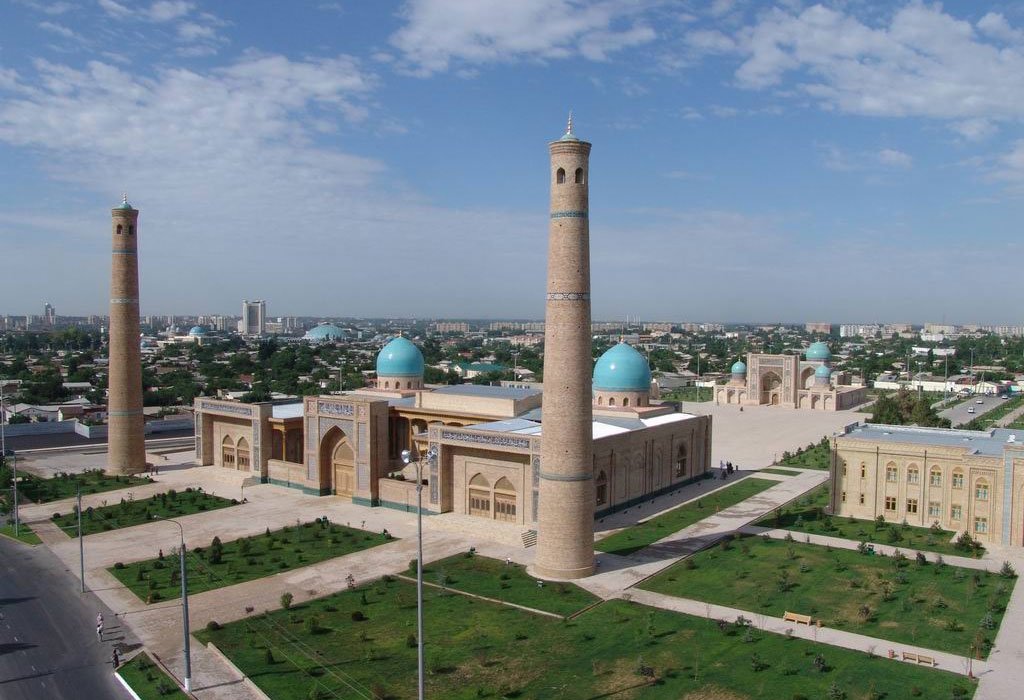
The Khast Imam complex — the religious center of Uzbekistan, housing the world’s oldest surviving Quran (a 7th-century manuscript written on deer skin, reportedly once owned by the Caliph Uthman ibn Affan, brought to Tashkent by Timur after his campaigns in Arabia) — is genuinely one of the most significant Islamic manuscripts accessible to non-Muslim visitors anywhere, and receives a fraction of the attention it deserves.
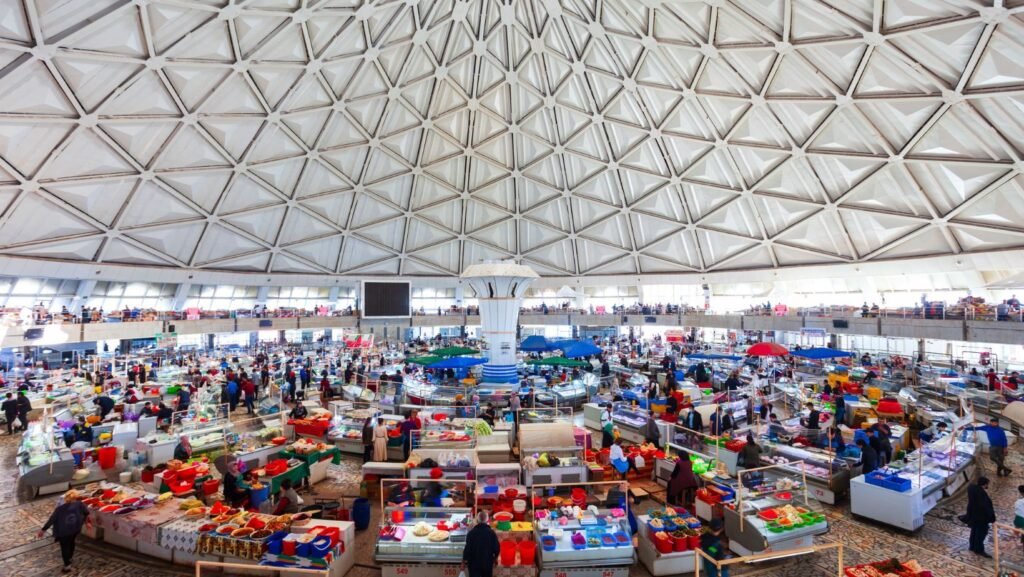
The Chorsu Bazaar — a covered dome market in the old city, one of the largest traditional markets in Central Asia — is the finest market experience in Uzbekistan: spice stalls with pyramids of cumin, coriander, saffron, and the Uzbek spice blends that characterise plov; dried fruit and nut sellers with varieties of apricot, fig, walnut, and pistachio; the particular organized chaos of a market that has operated on this site for millennia.
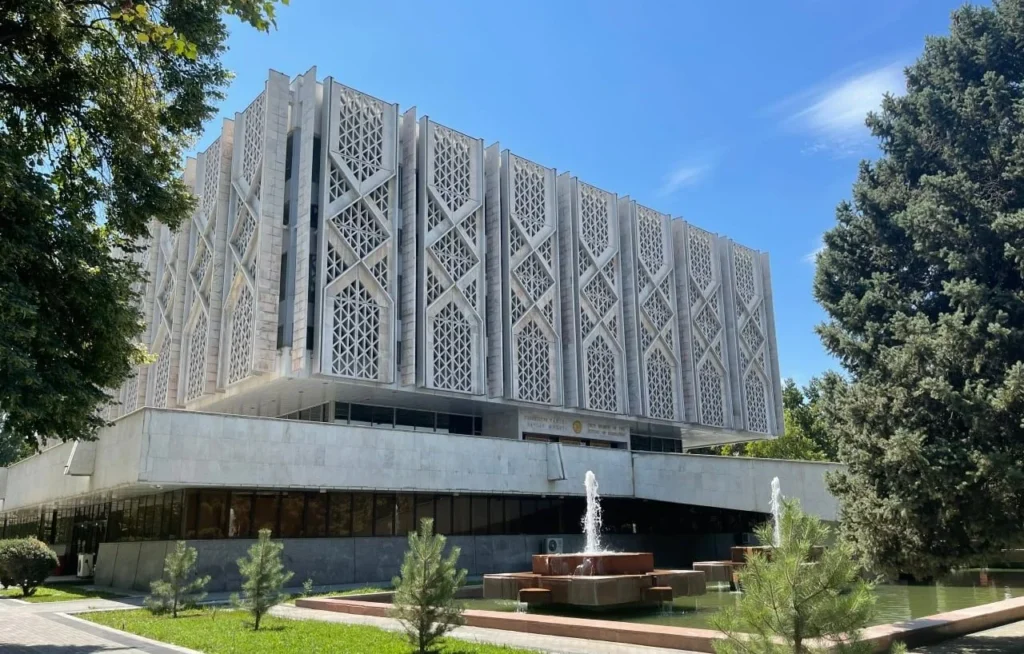
The Soviet modernist architecture of central Tashkent — built after the 1966 earthquake that destroyed most of the old city — is worth a specific architectural walk: the metro stations (each designed in a different style, collectively constituting a gallery of Soviet public art), the Amir Timur Square ensemble, and the specific quality of Soviet Central Asian architecture that attempts a synthesis between Stalinist grandeur and Uzbek tilework tradition with genuinely interesting results.
TrotRadar Tashkent daily budget: $25–45
Bukhara: The Silk Road’s Most Intact Medieval City
Bukhara is TrotRadar’s preferred Silk Road city for travelers who want to understand the architecture rather than simply photograph it — because Bukhara’s preservation is more comprehensive and more contextual than Samarkand’s restored grandeur. The historic center functions as a living city overlaid on a medieval street plan: domed toki (covered bazaar domes) still covering the intersections where trades were historically conducted, caravanserais converted to guesthouses but retaining their courtyard structure, and madrasas that are now gallery-guesthouse hybrids but architecturally intact.
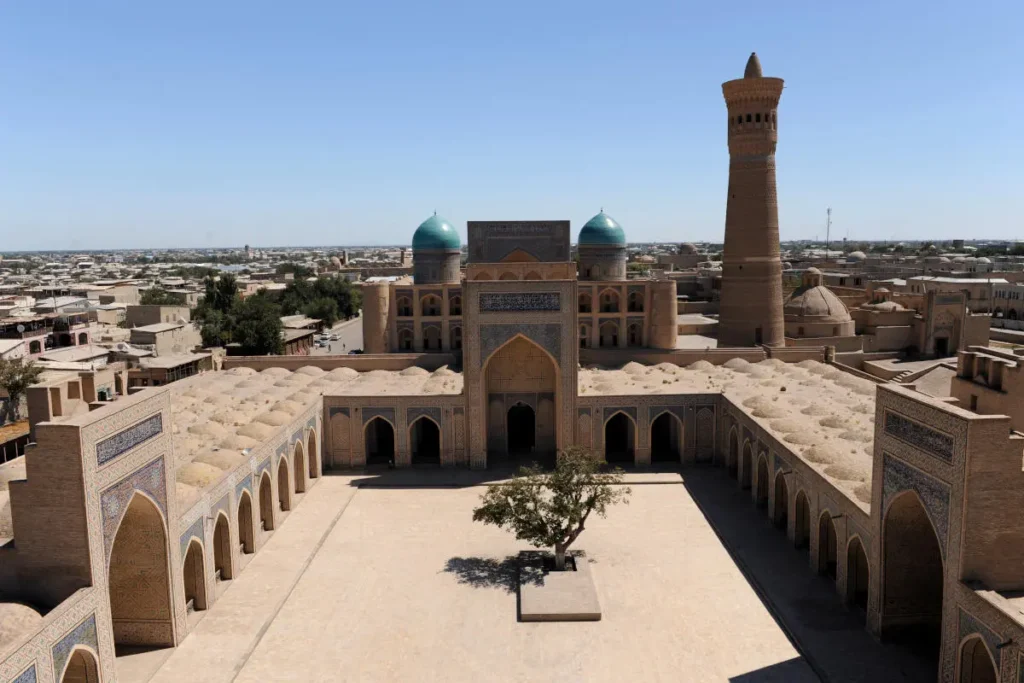
The Poi Kalon complex — the mosque, minaret, and madrasa ensemble at Bukhara’s center — provides the city’s most extraordinary architectural moment: the Kalon Minaret (built 1127, 46 metres tall, the only structure Genghis Khan reputedly commanded be left standing when he destroyed Bukhara in 1220), the Kalon Mosque (rebuilt in the 16th century, its courtyard capable of holding 10,000 worshippers), and the Mir-i-Arab Madrasa opposite (still an active religious school, one of the very few that continued operating through the Soviet period).
The Ark Fortress — the ancient citadel at the western edge of the old city, occupied continuously from the 5th century BCE to 1920 when it was bombed by the Red Army during the conquest of Bukhara — provides the historical framing for everything else. The museum inside covers the Emirate of Bukhara’s last century with remarkable documentary detail.

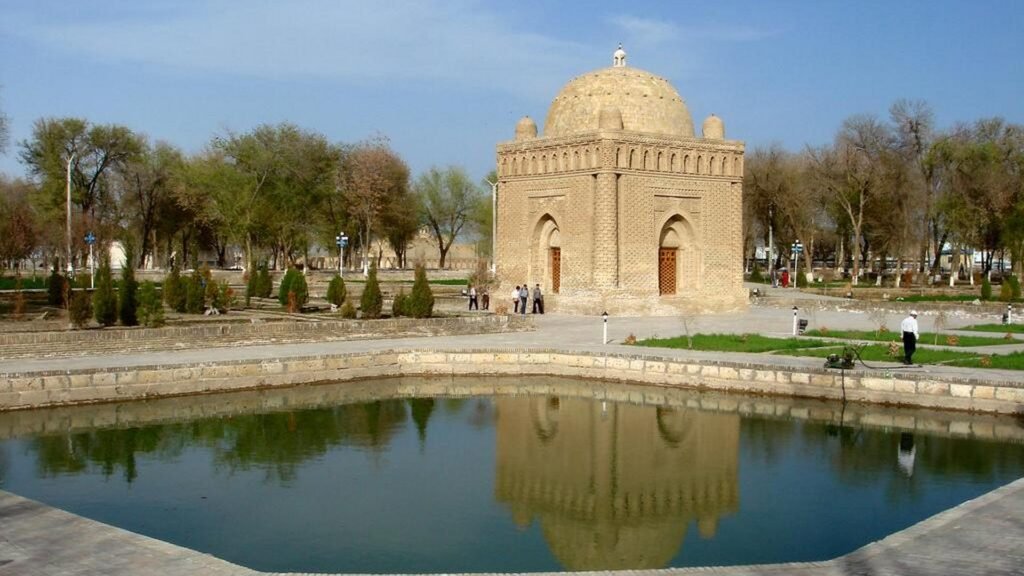
The Samanid Mausoleum in the city’s park — built between 892 and 943 CE, the oldest surviving Islamic mausoleum in Central Asia — is the building that most rewards patient examination: a cube of fired brick in a pattern that makes the bricks themselves the ornament, achieving a visual complexity through structural repetition that later tilework traditions never quite equalled.
TrotRadar’s Bukhara food note: the old city’s courtyard restaurants, in former caravanserai buildings, serve the finest plov in Uzbekistan — particularly at the Lyabi-Hauz pool area restaurants where the lunchtime plov service attracts locals and travelers equally. Cost: approximately $3–5 USD for a full plate.
TrotRadar Bukhara daily budget: $25–45
For the Samarkand architectural context that frames everything in this guide, read TrotRadar’s companion Samarkand Uzbekistan travel guide — covering the Registan, Shah-i-Zinda, and the Timurid capital in detail.
Khiva: The Walled City That Exists Outside Time
Khiva is the most isolated and most preserved of the three Silk Road cities — and the one that produces the strongest sense of temporal dislocation. The Ichan Kala (inner walled city) is a UNESCO World Heritage Site of extraordinary completeness: mudbrick walls enclosing a network of mosques, madrasas, minarets, caravanserais, and palaces that constitute one of the finest surviving medieval Islamic urban environments on earth.
The city feels different from Bukhara and Samarkand in part because it remained in active use as the capital of the Khanate of Khiva until the Soviet period — the buildings were maintained by their occupants rather than preserved as monuments. Walking the Ichan Kala at dusk, when the tour groups have returned to their hotels and the light turns the mudbrick walls amber, produces the specific feeling of having stepped into a functioning medieval city rather than a reconstruction.

The Islam Khodja Minaret (57 metres, the tallest in Khiva, built 1910 — climb for panoramic views over the inner city: approximately $2 entry), the Kalta Minor (Short Minaret) (never completed, its base diameter so large that the intended height was abandoned — covered in the finest tilework in Khiva), and the Tosh-Hovli Palace (the Khan’s summer residence, its harem quarters the most ornately decorated domestic interior in the city) are TrotRadar’s must-visit selections within the Ichan Kala.

Staying inside the walls: Several guesthouses and small hotels occupy restored buildings inside the Ichan Kala — TrotRadar strongly recommends staying inside rather than in the modern outer city. The experience of the walled city at dawn, before the day visitors arrive, is what makes Khiva memorable. Guesthouse rates inside the walls: $30–70/night.
TrotRadar Khiva daily budget: $25–50
The Fergana Valley: Craft Traditions Off the Main Circuit
The Fergana Valley — a broad agricultural plain in eastern Uzbekistan, shared with Tajikistan and Kyrgyzstan, accessible from Tashkent by train or road in 3–4 hours — is the part of Uzbekistan that most travelers skip entirely and that TrotRadar recommends for travelers with an extra two or three days.
The valley is the center of Uzbekistan’s finest craft traditions:
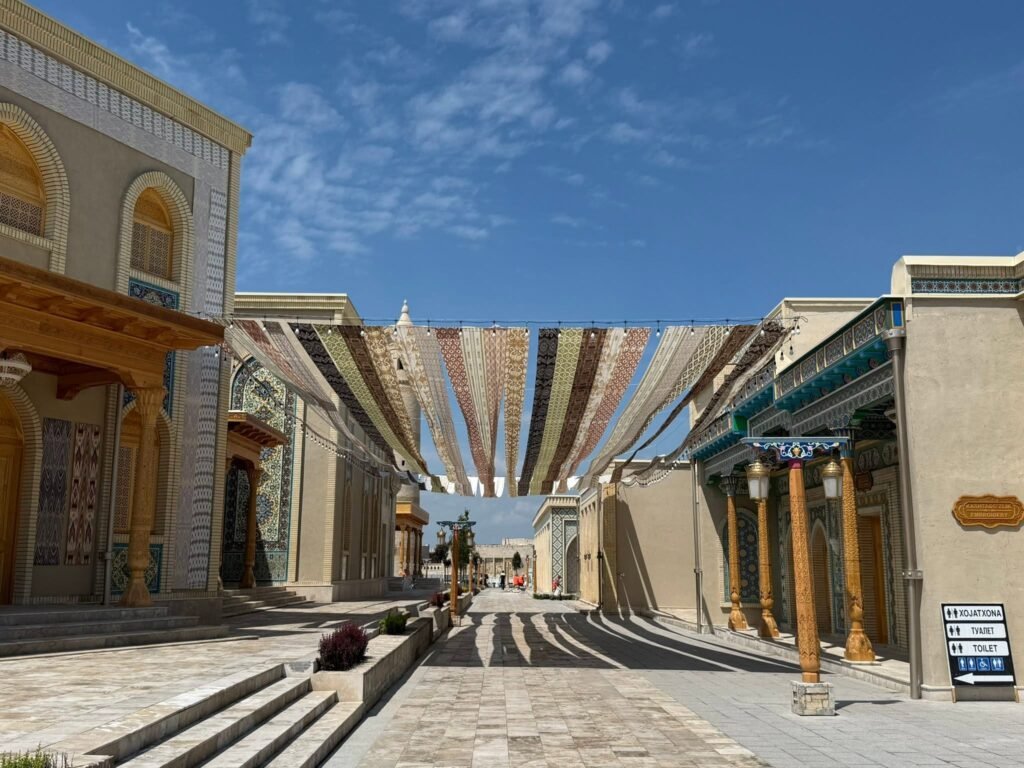
- Margilan — the silk weaving capital, where the Yodgorlik Silk Factory still produces traditional ikat fabric (a resist-dye technique producing the geometric patterns characteristic of Central Asian textile art) on hand-operated looms. Tours of the factory are free; the textile quality is among the finest in Central Asia
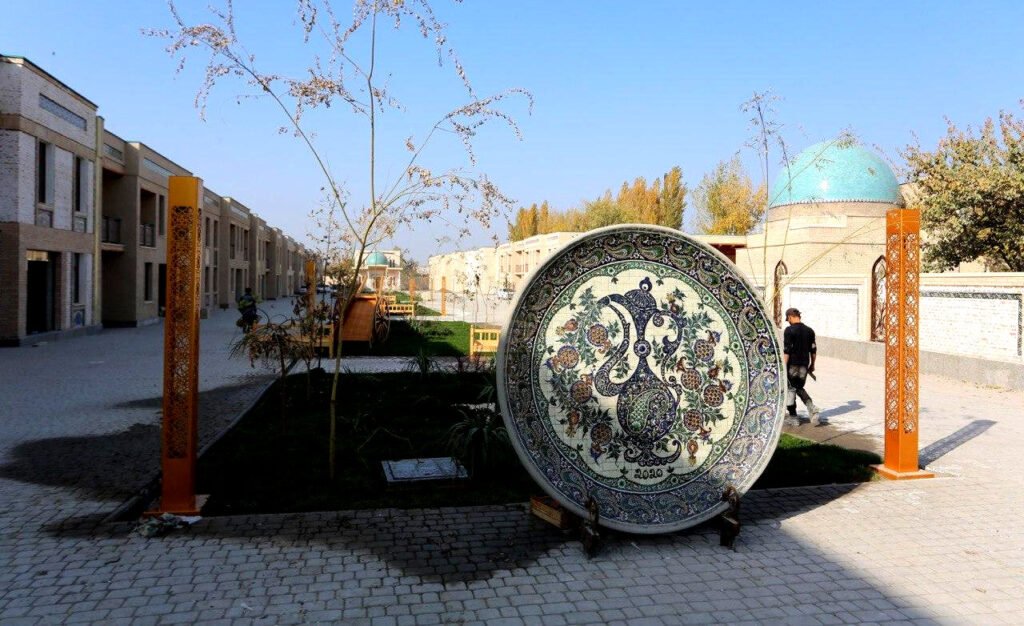
- Rishtan — the ceramics village, where blue and white pottery with specific Rishtan geometric patterns has been produced for centuries. Workshop visits are available; the pottery is the finest souvenir from Uzbekistan
- Kokand — the Fergana Valley’s main city, with a 19th-century Khan’s palace of extraordinary room decoration and a Friday mosque whose wooden ceiling is covered in carved and painted geometrics of the highest craftsmanship

The Complete Uzbekistan Circuit: TrotRadar’s Recommended Order
For a 10–14 day Uzbekistan circuit, TrotRadar recommends:
- Tashkent (2 nights) — Khast Imam, Chorsu Bazaar, Soviet metro architecture
- Fergana Valley (2 nights) — Margilan silk, Rishtan ceramics, Kokand palace (optional detour, highly recommended)
- Samarkand (3 nights) — Registan, Shah-i-Zinda, Observatory, Bibi-Khanym
- Bukhara (3 nights) — Poi Kalon, Ark Fortress, Samanid Mausoleum, old city walking
- Khiva (2 nights) — Ichan Kala, inside-the-walls stay, dawn walk before day visitors arrive
- Fly Urgench–Tashkent for return flight
Transport between cities:
- Tashkent–Samarkand: Afrosiyob high-speed train, 2 hours, $10–18
- Samarkand–Bukhara: Afrosiyob, 1.5 hours, $8–15
- Bukhara–Urgench (for Khiva): Uzbekistan Airways flight, 1 hour, $40–60 (recommended over 12-hour train)
- Urgench–Tashkent: Uzbekistan Airways, 1.5 hours, $50–80
Practical Uzbekistan Notes from TrotRadar
Visas: E-visa available online for most nationalities (e-visa.uz) — processing 3–5 days, approximately $20–30 USD for a 30-day tourist visa. Citizens of many countries can enter visa-free for up to 30 days — check current policy for your nationality.
Currency: Uzbek Som (UZS). Approximately 12,500–13,000 UZS per USD at recent rates. Exchange at banks or authorised exchange offices — Tashkent airport has good ATM coverage; carry some cash for smaller cities where card acceptance is limited.
Best time to visit: April–May and September–October — mild temperatures (18–28°C), avoiding the summer heat (July–August can exceed 40°C in Bukhara and Khiva).
TrotRadar Uzbekistan overall daily budget: $25–50/day — one of the most affordable quality heritage destinations in Asia. For the broader Central Asia context, read TrotRadar’s digital nomad destinations guide — which covers Tashkent’s improving infrastructure for remote workers.
The TrotRadar Verdict on Uzbekistan Beyond Samarkand
The Uzbekistan travel guide beyond Samarkand conclusion is that the country is genuinely greater than its most famous image — not because Samarkand doesn’t justify the attention but because Bukhara’s intimacy, Khiva’s completeness, and the Fergana Valley’s craft traditions add dimensions to the journey that Samarkand alone can’t provide. The high-speed rail connections make the full circuit logistically straightforward. The prices make it financially accessible. TrotRadar says: do all three, and then add the Fergana Valley if the days allow.
Find Your Uzbekistan Silk Road Deal
TrotRadar features complete Silk Road circuit packages covering Samarkand, Bukhara, and Khiva with rail connections, accommodation inside the walled cities, and Fergana Valley craft tour extensions. The full Silk Road experience awaits. Browse TrotRadar’s Uzbekistan travel offers →