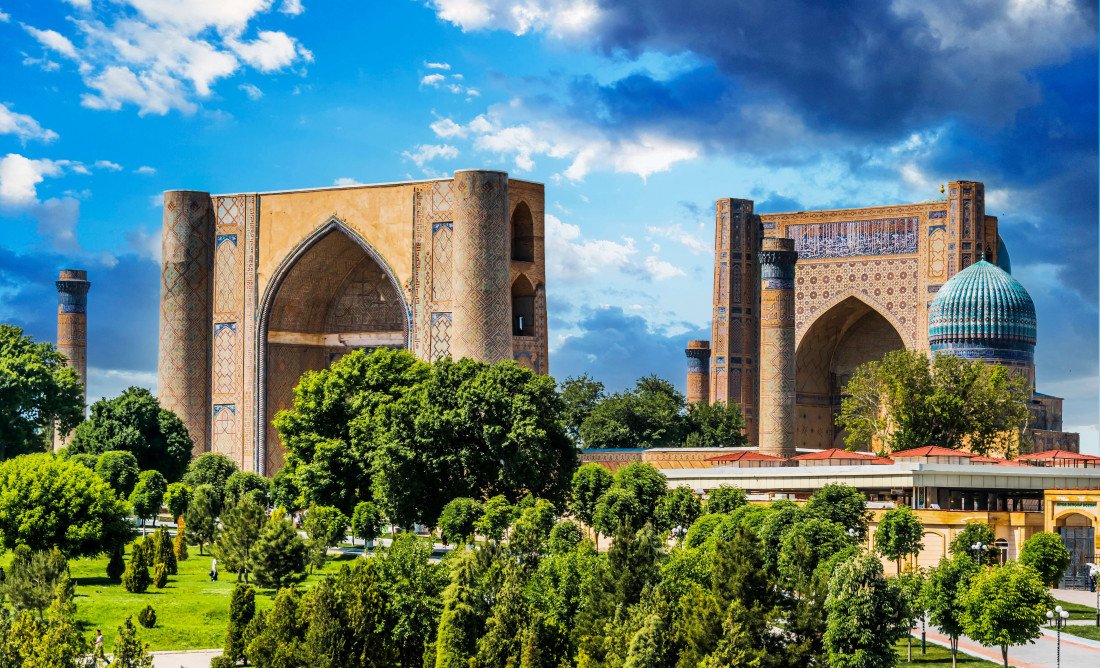
There is a moment that happens to almost every traveler who visits Samarkand for the first time. You turn a corner somewhere near the center of the old city, and the Registan simply appears — three enormous madrasas arranged around a central square, their facades covered in turquoise, cobalt, and gold geometric tilework that catches the light differently at every hour. The scale of it is not what you expected. The condition of it is not what you expected. And the fact that there are relatively few other tourists standing there with you is absolutely not what you expected.
At TrotRadar, Samarkand sits in a very specific category: destinations where the reality not only matches the reputation but exceeds it in ways that photographs fundamentally cannot convey. This Samarkand Uzbekistan travel guide is for the traveler who looked at that photograph once and started checking flight prices — and who deserves to know exactly what awaits them.
TrotRadar Tip: Samarkand is best experienced as part of the full Uzbekistan Silk Road circuit — Tashkent, Samarkand, Bukhara, and Khiva. For the complete country guide, read our dedicated Uzbekistan beyond Samarkand guide. For current flight deals to Tashkent from European cities, check TrotRadar’s Uzbekistan offers page.
Getting to Samarkand Uzbekistan: Flights, Trains & Visa Tips
Uzbekistan has made genuine, meaningful efforts to develop its tourism infrastructure over the past several years, and getting to Samarkand has become considerably more straightforward than it was even five years ago.
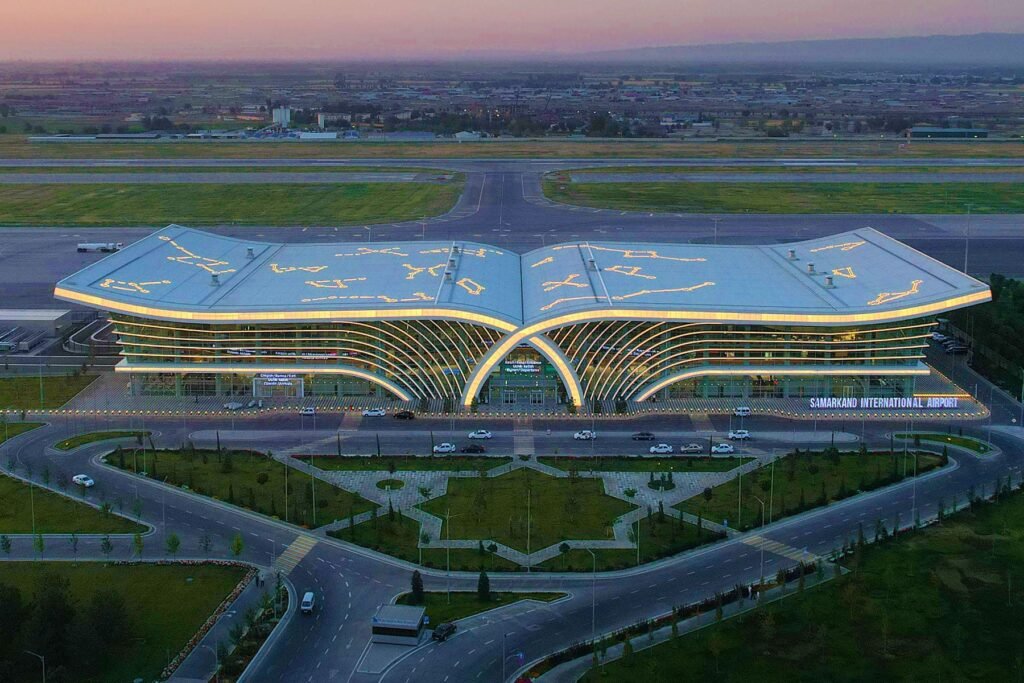
By air: Samarkand International Airport (SKD) receives direct flights from Istanbul (Turkish Airlines), Moscow, Dubai, and various destinations via Uzbekistan Airways. The most common routing from Western Europe is a single connection through Istanbul or Dubai — total journey times of around 7–9 hours.
By train: Uzbekistan’s Afrosiyob high-speed train runs between Tashkent and Samarkand multiple times daily, covering the roughly 340 km in under 2 hours at speeds up to 250 km/h. Tickets cost approximately €10–20 depending on class — this is genuinely one of the best rail value propositions in Central Asia and makes the Tashkent–Samarkand–Bukhara corridor extremely logical as a travel itinerary.
Visas: Uzbekistan operates a relatively straightforward e-visa system for most nationalities, available online through the official portal. Processing typically takes 3–5 business days and costs around $20–30 USD. Citizens of many countries can also enter visa-free for stays up to 30 days — check current policy for your passport before booking.
The Registan: The Monument That Justifies the Journey
If Samarkand has a defining image, it is the Registan — and TrotRadar considers it the most extraordinary public square in Asia, full stop. The Registan is a public square flanked by three monumental madrasas: the Ulugh Beg Madrasa (1420), the Sher-Dor Madrasa (1636), and the Tilya-Kori Madrasa (1660). Each is roughly 35 meters tall at its entrance iwan (arch), and each is covered in geometric and calligraphic tilework of a quality that was at the absolute pinnacle of Islamic architectural achievement at the time of construction.
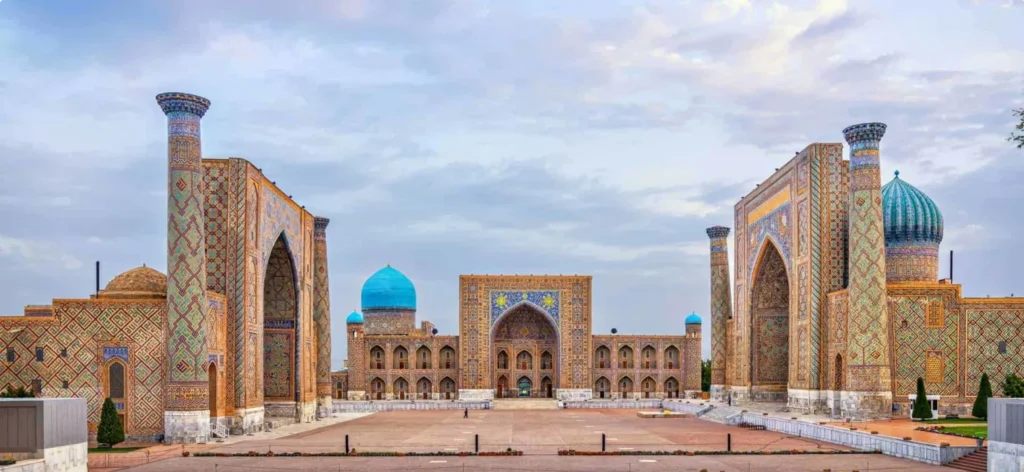
Walking across the square at different times of day gives you three different experiences. Morning light hits the Ulugh Beg facade from the east, illuminating the deep blues and greens most clearly. Midday puts the full square in even light that’s better for photography. Late afternoon turns the mosaics gold in a way that photographs struggle to capture. If you can manage it, visit twice — once early in the morning and once around sunset.
Entry is around $5–8 USD; a combined ticket covering several monuments is available and represents the better value if you’re visiting more than one site. TrotRadar strongly recommends an audio guide or local guide here — the historical depth behind the construction, the patrons who commissioned each building, and the symbolic iconography of the tilework rewards explanation.
Shah-i-Zinda Samarkand: The Avenue of Mausoleums & Islamic Tilework
A short walk northeast of the Registan, Shah-i-Zinda (“The Living King”) is a necropolis — a street of tombs — that has been accumulating mausoleums since the 11th century. The result is one of the most visually concentrated experiences of Islamic funerary architecture anywhere in the world: a narrow lane rising upward through a sequence of portal facades, each in a slightly different style and color palette but unified by the extraordinary quality of their tile and mosaic work.
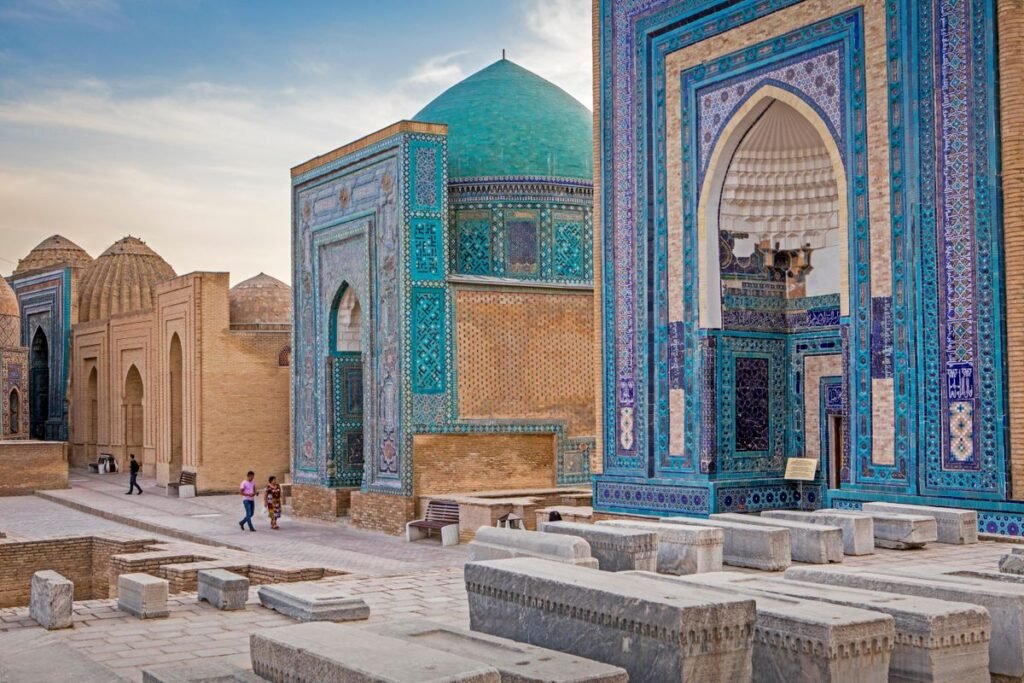
The tilework at Shah-i-Zinda achieves things that the larger monuments don’t — the human-scaled corridors let you study the geometry and craftsmanship up close in a way that the towering facades of the Registan don’t allow. The TrotRadar team consistently rates this as the most rewarding hour in Samarkand for design and architecture lovers. Go slowly. Let your eyes find the patterns. It’s worth at least two hours.
The complex functions as both an active religious site and an architectural monument, so moderate dress and a respectful approach to photographing worshippers matters. For context on how this fits into the broader Central Asia architecture conversation, see TrotRadar’s global architecture destinations guide.
Bibi-Khanym Mosque Samarkand: Timur’s Grandest Ruin on the Silk Road
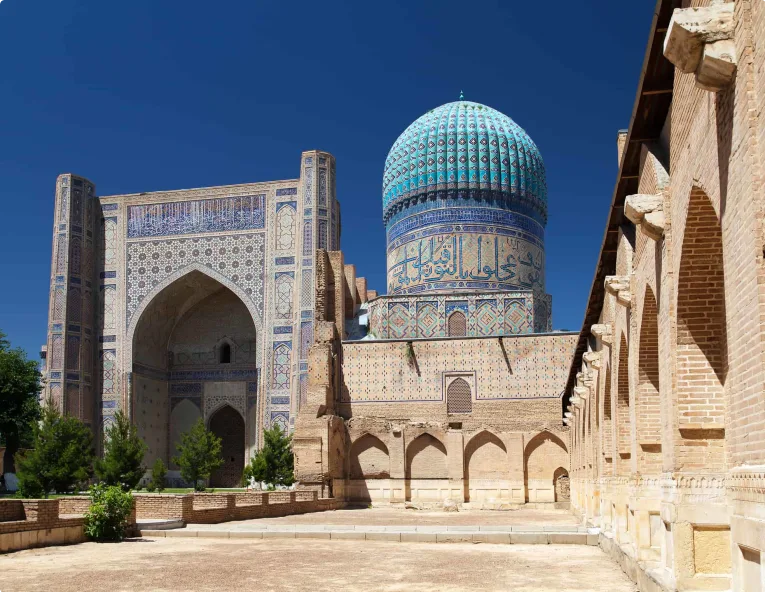
The Bibi-Khanym Mosque was, at the time of its completion in 1404, the largest mosque in the Islamic world. Timur commissioned it after his return from the conquest of India, and the scale of ambition was outrageous — the main dome reached 40 meters, the minarets over 50 meters, and the courtyard was designed to hold the entire population of the city simultaneously for Friday prayers.
The ambition exceeded what the engineering of the era could sustain. The mosque began deteriorating within decades of completion and was further damaged by an earthquake in the 15th century. What you visit today is a partial reconstruction alongside original ruins that give you a more honest sense of the passage of time than the fully restored Registan.
The Siab Bazaar, directly adjacent to the mosque, is Samarkand’s main traditional market and one of the most atmospheric in Central Asia — stacked with non (the circular Uzbek bread baked in clay ovens), spice pyramids, dried fruit, and the local specialty: Samarkand bread, considered by many Uzbeks to be the finest in the country.
Ulugh Beg Observatory Samarkand: Uzbekistan’s Silk Road Astronomy Legacy
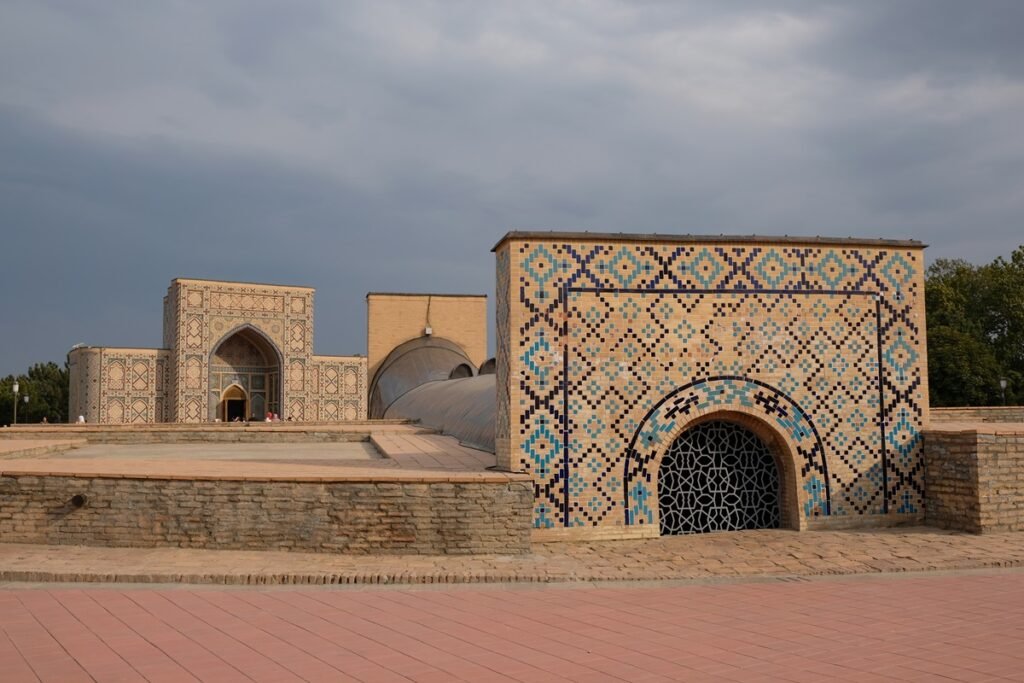
One of Samarkand’s most historically significant but least-visited sites sits on a hill northeast of the center — the remains of the observatory built by Ulugh Beg, Timur’s grandson and one of the most remarkable astronomers of the pre-telescope era.
In the early 15th century, Ulugh Beg constructed a three-story observatory containing a quadrant of 40-meter radius — the largest of its kind in the world at the time. Using it, he and his team of astronomers produced a star catalogue of over 1,000 stars with an accuracy that wasn’t surpassed for nearly 200 years. His calculation of the length of the sidereal year was accurate to within 58 seconds of modern measurements.
The observatory was destroyed after Ulugh Beg’s assassination in 1449, and only the buried lower section of the great quadrant arc has been excavated. The small adjacent museum tells the story well. It receives a fraction of the visitors that the Registan does and rewards the detour significantly for anyone interested in the history of science alongside the history of architecture.
TrotRadar recommends combining the observatory visit with the full Silk Road circuit — our guide to Uzbekistan beyond Samarkand covers Bukhara, Khiva, and the Fergana Valley in detail, including transport logistics between all four cities.
Food, Tea Houses, and What to Eat in Samarkand
Uzbek cuisine is one of the great underappreciated food traditions of Asia — built around lamb, rice, bread, and an extraordinary range of dried fruits and nuts, with Persian, Turkic, and Russian influences all visible in different dishes. At TrotRadar, we consider Uzbek food one of the most overlooked culinary destinations in the world.
Plov (pilaf) is the national dish and something of a religion in Uzbekistan. Samarkand plov uses a slightly different technique from Tashkent plov — the rice is prepared separately in some versions, and the result is lighter. The best place to try it is from a dedicated oshxona (plov house) that makes a single large batch in the morning and serves until it runs out — typically by 1–2 PM.
TrotRadar food cost benchmarks for Samarkand:
- Plov lunch at a local oshxona: $1.50–3 USD
- Full dinner at a mid-range restaurant: $5–10 USD
- Shashlik (per skewer): $0.50–1 USD
- Green tea at a chaikhana: $0.30–0.50 USD
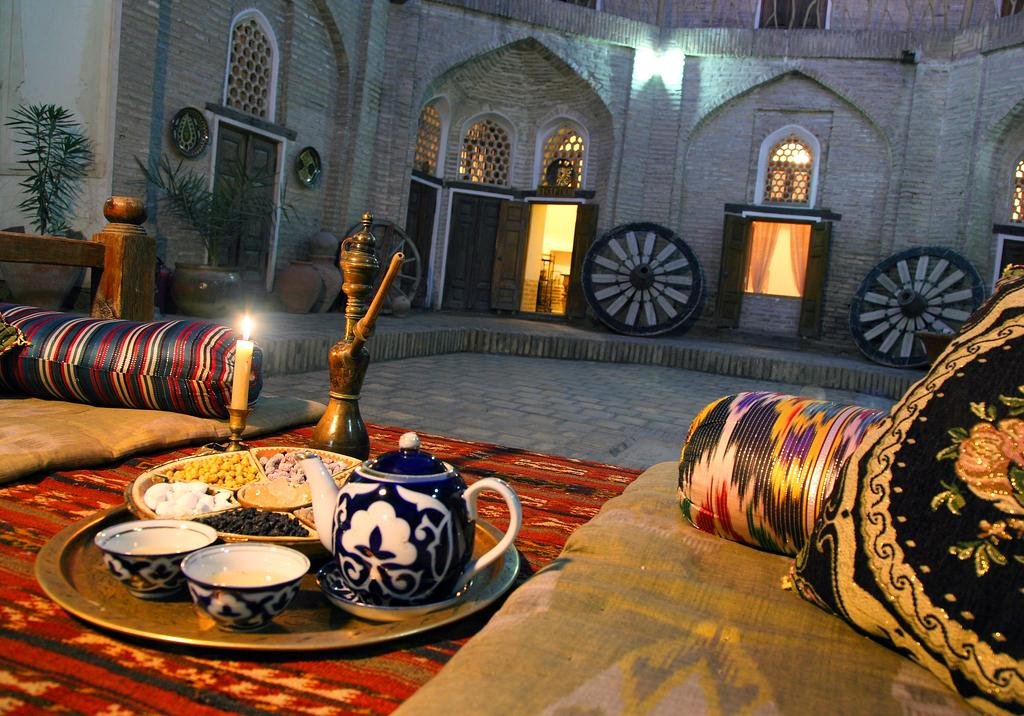
Tea house culture: Uzbek chaikhanas (tea houses) are social institutions — platforms under mulberry trees where men sit for hours over green tea, bread, and conversation. As a visitor you’re welcome to join the perimeter of this culture; ordering a pot of green tea and sitting for twenty minutes costs almost nothing and tells you more about daily life than any monument.
Practical Samarkand Travel Notes from TrotRadar
Currency: Uzbek Som (UZS). As of recent reports, approximately 12,500–13,000 UZS per 1 USD. Cash is widely preferred; ATMs in the city center dispense Som reliably but carry some USD as backup in smaller cities.
Accommodation: A range from basic guesthouses at $15–25/night to well-restored boutique hotels in the old city at $60–120/night. Several guesthouses operated by local families sit within walking distance of the Registan and offer home-cooked breakfasts included in the rate.
When to visit: April–May and September–October are the optimal windows — mild temperatures (15–25°C), lower tourist volume than summer, and the distinctive light of shoulder seasons on the tile facades. Summer (June–August) brings intense heat (35–42°C).
TrotRadar Samarkand daily budget: Remarkably affordable. A comfortable traveler budget runs $30–50 USD/day including accommodation, all meals, entry fees, and local transport. Budget travelers stretching can manage on $20–30 USD/day.
The TrotRadar Verdict on Samarkand
Samarkand sits in that rare category of destinations where the reality matches the history-book description without significant asterisks. The Registan is as extraordinary as the photographs suggest. The food is better than you expected. The people are genuinely welcoming in a way that doesn’t feel performed for tourism’s benefit. And the infrastructure has matured enough that visiting independently is straightforward for any traveler comfortable with navigating an unfamiliar city.
The journey requires effort. That effort returns something increasingly rare in modern travel — the specific satisfaction of standing somewhere genuinely remarkable that most people in your life have never been and couldn’t quite place on a map.
Find Your Uzbekistan Silk Road Deal
TrotRadar has curated current deals on flights to Tashkent, high-speed rail passes, and guided Silk Road tours covering Samarkand, Bukhara, and Khiva. The Silk Road is closer than you think. Browse TrotRadar’s Uzbekistan travel offers →